Senate Democrat pitches CDPAP compromise amid battle over home care

As the state eyes eliminating over 600 home care agencies, citing fraud, one lawmaker pitched a bill to reverse the planned overhaul.

By Raga Justin

Capitol Bureau, Albany Times Union

Sep 5, 2024
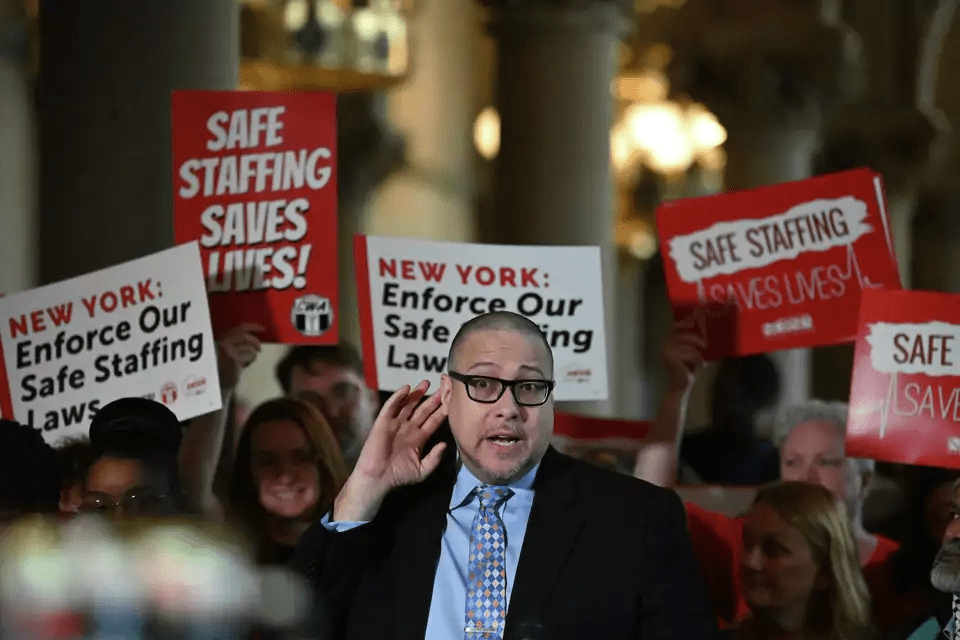
State Sen. Gustavo Rivera, a Bronx Democrat, introduced legislation this week that he said offers a compromise between Gov. Kathy Hochul’s plan to overhaul a popular home care program and the middlemen agencies who are fighting to keep their lucrative businesses operating. Will Waldron/Times Union

ALBANY — A Democratic lawmaker unhappy with the proposed changes to a widely popular home care program is pitching a last-minute legislative fix he contends would offer a compromise between Gov. Kathy Hochul’s budget leaders, who are concerned with increased Medicaid costs, and the industry that could be wiped out by its overhaul. 

The bill set to be introduced by state Sen. Gustavo Rivera on Friday comes less than a month before an Oct. 1 deadline for the state Department of Health to choose a vendor to replace over 600 businesses who serve as middlemen in the popular Consumer Directed Personal Assistance Program. 

That program has been the focus of mounting pressure campaigns this summer since Hochul said she intended to completely restructure it within a year in an attempt to rein in what she has characterized as rampant fraud. That controversial shakeup would involve eliminating the role of hundreds of “fiscal intermediaries,” or companies that act as brokers between Medicaid and patients with long-term medical conditions or disabilities who can choose their own caregivers, including family members. 

Instead, Hochul said New York would contract with a single vendor to streamline and administer CDPAP services to over a quarter million New Yorkers. 

That didn’t go over well with the over 600 fiscal intermediaries scattered across the state. Over the summer, a group called Alliance to Protect Home Care spent millions of dollars attempting to get state lawmakers to halt the shakeup or reverse it entirely. They also filed a lawsuit in August to try and thwart the proposed changes. 

Now, the lawmaker chairing the state Senate’s Health Committee has introduced a bill that would halt the transition to a single fiscal intermediary while implementing new guardrails to protect against some of the overspending Hochul has decried. 

Rivera, a progressive Democrat from the Bronx, called Hochul’s plan an “unreasonable” attempt to fix the CDPAP program and said his legislation would create a licensing process to better regulate the cottage industry of fiscal intermediaries that has sprung up around the program in recent years. 

Under the proposed bill, more power would be given to the commissioner of the Department of Health to require annual reporting from the home care agencies involved in the program, as well as require them to be licensed after April 1, 2026 through a new licensing process the department would also be tasked with creating. State officials have complained they do not have an exact number of fiscal intermediaries operating across the state. 

It would also require each business operating as a fiscal intermediary to pay a one-time licensing fee of $10,000, as well as require that the businesses be prohibited from advertising their services. Both clauses come in response to complaints that the program has in some cases encouraged unscrupulous behavior.

“I recognize that there are changes that are necessary, that there have been bad actors,” Rivera said. “But instead of throwing out the baby with the bathwater, it’s electrifying the baby in the damn tub. Let’s not do that. Let’s actually think through how this could be done more efficiently.”

Other provisions in the bill include: requiring the health commissioner to make regulations and issue guidance for shuttering fiscal intermediaries; establishing a process to discipline fiscal intermediaries that do not comply; setting up a registry for caregivers who are enrolled under the program, and creating minimum training requirements for caregivers. 

It’s unclear whether the bill will pacify both businesses who are angered that their services may soon be on the chopping block and Hochul, who has stood firm on the policy. Rivera said he’s spoken to stakeholders for months and is confident it would find favor among both Democrats and Republicans during the next legislative season. 

The program is beloved by numerous consumers but has also been criticized for its rapidly ballooning growth in recent years, at a time when Hochul and budget officials have attempted to control exorbitant health care costs.

After the change was unveiled during last-minute budget talks earlier this year, Rivera said he had been unhappy with its potential ramifications on Medicaid enrollees who receive services through the program. Advocates of the program have argued that funneling all of the paperwork and administrative requirements through a single company could be disruptive for the nearly 250,000 thousand clients.

n August, several Democrats in the Legislature protested the forthcoming changes in a letter to federal administrators with the Centers for Medicaid and Medicare, urging them to weigh in or halt the planned switch. 

Also in August, home care agencies who would be affected by the switch filed a lawsuit in state Supreme Court in Albany asking a judge to issue a temporary restraining order to halt the massive contract for a single fiscal intermediary. 

Whether Hochul will adjust the Oct. 1 deadline for the state to announce which vendor will receive the multi-billion-dollar contract remains to be seen.

Bryan O’Malley, who represents many of the fiscal intermediaries and has been spearheading the interest group lobbying to stop the overhaul, said in a statement he is pleased with Rivera’s bill.

“We applaud Sen. Rivera for introducing this bill and taking a stand against Gov. Hochul’s plan to gut New York’s home care program that allows 250,000 elderly and disabled to receive the health care they need from the comfort of their homes,” O’Malley said. “Handing over this critical program to one big company isn’t the answer and will potentially force thousands into expensive and overwhelmed nursing homes.”


Raga Justin is an investigative reporter covering politics and policy with the Capitol Bureau, where she was previously a Hearst fellow. She is a native Texan and University of Texas at Austin graduate and has worked for the Hearst Connecticut Media Group, the Dallas Morning News in Washington, D.C., and the Texas Tribune. Send tips, feedback or rants to raga.justin@hearst.com.

OPWDD New Proposed Rule Making – Supported Decision Making and Pathway to Employment

OPWDD has filed two new proposed regulations that both appear in the July 31st edition of the State Register.

The proposed regulatory updates enable OPWDD to further meet the goals in our 2023-2027 Strategic Plan. They include key elements and changes related to both supported decision-making and employment services, which will further support people in their independence. Both were also drafted in response to, and informed by, stakeholders. 

Supported Decision-Making

OPWDD is adding regulation Part 634, which includes rules necessary to implement New York Mental Hygiene Law Article 82, to ensure the appropriate adoption of supported decision-making practices within the OPWDD service system.

This new regulation does several things, including:

  • outline the supported decision-making process
  • set criteria for both formal and informal supported decision-making agreements
  • prescribe the authority of a formal supported decision-making agreement and a third party’s obligation to honor it
  • define the Care Coordination Organization’s role in the supported decision-making process
  • update notice requirements in existing OPWDD regulations

A full copy of the text can be found at the following link: https://opwdd.ny.gov/system/files/documents/2024/07/supported-decision-making-regulation-text_acc.pdf

Pathway to Employment Services

OPWDD is also replacing subdivision 635-10.4(h) with new language. Language was replaced to define what Pathway to Employment Services are, expand the types of allowable services, re-order the language to match other employment and vocational services to make the regulation clearer, require community-based vocational experiences for the person to assist in building a career path and set requirement for billing, training and documentation.

A full copy of the text can be found at the following link: https://opwdd.ny.gov/system/files/documents/2024/08/pathway-to-employment-reg-text-7.16.pdf

Thank you.

Office of Counsel

Bureau of Policy & Regulatory Affairs

NYS Office for People With Developmental Disabilities
44 Holland Avenue, Albany, NY 12229

OFFICE: (518) 474-7700  l  www.opwdd.ny.gov

OPWDD Invites You to Take the Care Coordination Program Evaluation Survey

Dear Friends,

On behalf of OPWDD and the American Institutes for Research, I am pleased to share an opportunity for people with lived disability experience and their family members to provide feedback on your experiences with care management.

OPWDD currently has a contract with the American Institutes for Research to conduct an independent evaluation of the Care Coordination program. The goal of the evaluation is to learn what parts of the program are working well and what areas could be improved.  

We know that those of you who interact on a regular basis with Care Coordination Organizations and care managers can help us understand how we can strengthen care management going forward. We hope you will take a few moments to participate in the Care Coordination Evaluation survey. The online survey will be open until August 26, 2024.

To participate in the survey visit: https://survey.alchemer.com/s3/7823011/OPWDDCareCoordinationSurvey

Learn more about this project at https://opwdd.ny.gov/american-rescue-plan-act-arpa.

I look forward to hearing your thoughts about this important service.

Thank you,

Willow Baer
Acting Commissioner

A Message From OPWDD’s New Acting Commissioner Willow Baer

Dear Friends and Colleagues,   

Commissioner Neifeld has departed OPWDD to focus on her growing family and I am honored to have been asked to serve as your next Acting Commissioner. I am grateful to Commissioner Neifeld for her years of service to our community and am humbled to continue to work with the amazing team at OPWDD in this new role, as well as our incredible community of self-advocates, parents, providers, and Care Coordination Organizations, as we continue to advance the agency’s mission of providing person-centered and quality services for people with developmental disabilities.  

My history with the agency as Executive Deputy Commissioner and, before that, as Deputy Commissioner and General Counsel has allowed me to be deeply involved in the operations and oversight of the agency.  I also have a very personal connection to our work, as a family member of a person with a developmental disability.  

I am grateful that, under Governor Hochul’s leadership, New York State has restored its status as a national leader in providing services to people with developmental disabilities with policies that prioritize greater independence, innovative housing options, and community integration.  I am so excited to continue to elevate this work and advocate with this community. 

When I think about how far our service system has come over the last 50 years, from one of institutionalization to one that prioritizes community inclusion, I’m encouraged  while remaining aware that there is much more to be done. Successful service systems must continue to evolve to meet changing needs and maximize new opportunities.  

Some of the areas within our strategic plan that I am particularly interested in prioritizing include: the use of emerging technology to support people to live more independently; cross systems work to ensure people with developmental disabilities have better access to appropriate healthcare; stabilizing OPWDD’s network of providers; and ensuring a more responsive, equitable, and accessible service system through data-driven decision-making which is also informed more directly by the experiences of those using our services.    

There are many hurdles that we still face, including the need for enough staff to support people, generations of caregivers who are aging and wondering what will happen to their loved ones when they are gone, a growing number of young families who have recently found out their child may need additional supports, and the turnover of care managers and direct support professionals. Please know I realize that none of these initiatives will succeed without continued investments in our workforce, additional cross-agency collaborations, improved communication, and new approaches to the critical work that we do.   

I look forward to partnering with and getting to know all of you in my new role. Together, we will keep working to ensure that New York is a state that is inclusive, supportive, and one where those with disabilities live with meaningful choice and are proud to call home.   

Sincerely, 

Willow Baer,
Acting Commissioner

A Warm Welcome toActing Commissioner, Willow Baer 

As of July 1, Executive Deputy Commissioner Willow Baer has assumed the role of Acting Commissioner of OPWDD. Having served as the second in command at the agency for the last year after returning to OPWDD from an interim position as Assistant Counsel to the Governor and from her role as Deputy Commissioner and General Counsel at the New York State Office of Children and Family Services, Willow Baer is well prepared to lead the agency as it meets the stated goals of its Strategic Plan. Prior to working with OCFS, Willow spent six years at OPWDD, most recently serving as Deputy Commissioner and General Counsel. 

Willow initially joined OPWDD in 2015 as an Associate Counsel after serving as General Counsel at the NYS Justice Center.

Willow has spent much of her career working to ensure that people with developmental disabilities and their families are afforded the best service system possible. Welcome, Acting Commissioner Baer!

Celebrating the 25th Anniversary of the Olmstead Decision

Dear Friends and Colleagues,

Today, we celebrate the 25th Anniversary of the Supreme Court’s Olmstead Decision. This law enshrines the rights of people with disabilities to receive services in their communities rather than in institutions. It is a day also to celebrate and acknowledge the many years of advocacy that came before this landmark decision by those who refused to believe that society was not designed to be inclusive for people with disabilities. Instead, they fought for the right for people with disabilities to live, work and receive their healthcare in communities of their choice. I am proud to work for an administration that prioritizes the needs of people of all abilities, and OPWDD looks forward to thoroughly examining New York’s Olmstead Plan for ways to make even more meaningful change for those it impacts the most.

The spirit of the Olmstead Decision has always been at the heart of the developmental disabilities service delivery system and everything OPWDD does. By continuing to support and strive for increased independence and choice for people with developmental disabilities, we have transformed from a system of institutionalization to one that prioritizes community integration and recognizes the inherent autonomy and dignity of each person.

I am so grateful that OPWDD’s guiding policies have evolved and transformed to best meet the needs of people with developmental disabilities over the last 50 years. And I know that we will continue to work side-by-side with self-advocates, their loved ones, and our provider partners to effectuate even more positive change in the future. In the last few years alone, New York State and OPWDD have put into motion several initiatives to improve the lives of people with disabilities and foster independence. These include the creation of the Office of the Chief Disability Officer, a new supported decision-making option that enables people with developmental disabilities to direct their own lives with the help of a circle of trusted people instead of through traditional guardianship arrangements, expanding supportive housing models, increasing vocational training opportunities, and encouraging businesses to employ people with developmental disabilities, to name just a few.

As we reflect on the progress people with disabilities have made since Olmstead, we must not lose sight that the very things we continue to advocate for are the fundamental rights of all human beings, regardless of their disability status.  These include the right to enjoy meaningful relationships with friends, family, and other people, the right to experience personal health and growth, and to fully participate in their community. Let this year’s milestone anniversary remind each of you of the power of advocacy and strengthen your individual efforts towards achieving full inclusion.

Sincerely,


Kerri E. Neifeld
Commissioner

2024 Strategic Planning Forums ContinueOPWDD WANTS TO HEAR FROM YOU!

There is still time to join us for one of our 2024 Strategic Planning Forums to share your feedback on our 2023 – 2027 Strategic Plan. At each forum OPWDD staff will provide updates on our Strategic Plan, respond to pre-submitted questions, and listen to your feedback during our public comment period.

There are two remaining opportunities to attend in-person forums and two opportunities to participate in statewide virtual forums.

In-Person Forums

To participate in an in-person forum, visit our website where you can register, submit questions, and sign up for public comment.

  • Hudson Valley (Rockland) June 18, 4:30 – 6:30 PM New City Library – High Tor Mtg. Room 220 N Main St. New City, NY 10956
  • NYC (Bronx) July 9, 11 AM – 1 PM Lefrak Auditorium of the Price Center Albert Einstein College of Medicine 1301 Morris Park Ave. Bronx, NY 10461
REGISTER FOR AN IN-PERSON FORUM HERE

Virtual Forums

To register to participate in one of the virtual forums, use the links below.

Learn about Supported Decision-Making

MEMBER AND FAMILY FORUM
SUPPORTED DECISION-MAKINGOnline Tuesday, May 14, 6–7 p.m.

 Supported Decision-Making (SDM) is when people with disabilities get help from trusted people to make decisions. They still keep all their rights. In New York, SDM is seen as a legally recognized, less restrictive alternative to guardianship. Join us to learn more about this option.
REGISTER NOW
Questions? Contact Member Relations.

Times Union-NY’s largest health vendor linked to owner accused of fraud, neglect

N.Y.’s largest health vendor linked to owner accused of fraud, neglect

New York has contracts worth $27 billion with a company closely linked to a nursing home conglomerate that’s accused of fraud in a state attorney general’s investigation.

By Raga Justin April 7, 2024

The Schenectady Center for Rehabilitation and Nursing is a Capital Region nursing facility owned by the Bronx-based Centers Health Care. The nursing home conglomerate’s owner was named in a state attorney general’s lawsuit last year that alleged several fraud and neglect charges stemming from four other Centers facilities.

Will Waldron/Times Union

ALBANY— State Attorney General Letitia James stood at a podium late last June to announce her office had filed another civil case against allegedly nefarious nursing home operators, this one targeting four facilities and their Bronx-based parent company, Centers Health Care. 

James accused two Centers Health Care executives of orchestrating “multiple fraudulent schemes” that siphoned millions from the state’s Medicaid program to enrich themselves, their business associates and also to purchase a flailing Israeli airline. She pointed to disturbing, graphic examples of hundreds of elderly residents forced to endure harmful conditions for years because of the company’s alleged role in woefully understaffing nursing homes. 

“They ignored and violated laws meant to protect nursing home residents and they pocketed millions of dollars that should have gone to patient care,” James said of the nursing facilities, which are located in Queens, the Bronx, Westchester County and Buffalo.

The for-profit nursing home conglomerate’s chief executive officer, Kenneth Rozenberg, is the subject of intense ongoing scrutiny from state regulators as the attorney general’s civil lawsuit progresses through the court system. 

But six months after the allegations of widespread abuse and Medicaid fraud against him were made public, New York approved a 5-year, multibillion-dollar contract with the state’s largest and highest-paid managed care company — which Rozenberg also owns.

That company, called Centers Plan for Healthy Living, has had $27 billion worth of business with the state Department of Health since at least 2012, according to records maintained by the state comptroller’s office. Two contracts totaling nearly $17 billion have a start date of January 2022, likely around the time the attorney general’s investigation began. 

Still, both contracts were approved months after the investigation was made public — and after a state judge determined the attorney general’s office had presented enough evidence of fraud by Rozenberg and one of his close business partners and co-defendants, Daryl Hagler, to merit assigning an independent financial monitor for Centers Health Care’s operations. 

And last spring, while under scrutiny from state authorities and as the investigation crept closer to becoming public, Centers Plan for Healthy Living entered into a $10,000-per-month lobbying deal with noted health care lobbying firm Hinman Straub — the company’s first such activity, according to lobbying records, despite doing business within New York since at least 2013. 

The situation raises questions about what vetting process the state uses to examine its highest-paid vendors, especially in the complex world of government-funded health insurance plans. In that sector, the relatively new health payment system known as managed care has been criticized for, in some cases, enabling profit-seekers to flourish while providing care to the state’s most vulnerable residents. 

State contracts of that magnitude typically are reviewed by multiple entities, beginning with the agency which entered into them and then by the state comptroller’s office, which issues final approval.

Mark Johnson, a spokesman for the comptroller’s office, said the agency’s contract approval scope is narrow. Its vetting process is limited mostly to whether the vendor has violated labor laws by failing to pay workers proper wages.

Melissa Pomeroy, a spokeswoman for the Department of Health, said the agency would not comment on Rozenberg’s case because of pending litigation.

When asked about the department’s policy for dealing with vendors who are facing civil or criminal penalties, Pomeroy said there is a general review process at the time a contract is approved and when it is renewed. 

She noted that if a person or entity who is providing Medicaid services has “engaged in an unacceptable practice,” the department’s Office of the Medicaid Inspector General can impose sanctions, including censure or exclusion from state contracts.  

A spokesman for Centers Plan for Healthy Living and Centers Health Care declined to comment.

‘A duty to act’

The sole reference to Centers Plan for Healthy Living in the 366 pages of the state’s civil complaint against Rozenberg and Centers Health characterizes the insurance plan as the largest managed care organization in New York. These types of plans essentially function as the payment intermediary between Medicaid enrollees with intensive medical needs and their health care providers.

In the complicated parlance of health insurance, Managed Long Term Care plans help people who are chronically ill, have disabilities or otherwise need long-term care. The health plans help arrange for those medical services, like home health or nursing care, and receive payment from the joint state-federal Medicaid program to do so. 

New York has been increasingly reliant on Managed Long Term Care plans over the decades, and companies have flocked to provide such plans — including Rozenberg’s Centers’ conglomerate. 

ADVERTISEMENT

Article continues below this ad

Since at least 2012, the Department of Health has approved six contracts with the Staten Island-based Centers Plan for Healthy Living. Most recently, the department entered into two 5-year contracts beginning January 2022 and running until December 2026. That contract term is standard for Managed Long Term Care plans.

The first contract, worth $16.1 billion for services simply characterized as Managed Long Term Care, was approved by the state comptroller’s office on Dec. 15. Another agreement for $599 million for a health plan for dually-eligible Medicaid and Medicare enrollees was approved on Nov. 15. 

Both contracts would have been entered into by the Health Department around the time the massive investigation had been launched by the state’s Medicaid Fraud Control Unit, a bureau within the attorney general’s office dedicated, in part, to rooting out dishonest health care practitioners. 

Contained in that lawsuit are multiple allegations that Rozenberg and Hagler submitted misleading or false information to Department of Health regulators related to funding and ownership structures for some of their nursing homes. 

But officials elsewhere had quickly reacted to the severity of the allegations.

Last July, state Supreme Court Justice Melissa Ann Crane found evidence of “repeated and persistent fraud” so credible that she appointed a financial monitor and health monitor to assess and manage Centers Health Care’s operations. 

“Although respondents have promised to cease payments to related entities and that principals will take no further draws, the sheer magnitude and variety in the fraud that has allegedly persisted warrants the imposition of an independent financial monitor,” Crane wrote in a decision. “In all likelihood, the massive self-dealing will continue without a monitor.”

New Jersey officials also found the allegations serious enough to issue temporary suspension notices in January, targeting two facilities owned by Rozenberg and Hagler in that state. 

In a release, New Jersey State Comptroller Kevin Walsh cited “poor conditions … and evidence of massive Medicaid fraud in New York.”

“When there is evidence of fraud of this magnitude, and when a judge has acted to prevent further siphoning and self-dealing, we have a duty to act,” Walsh said. “To protect New Jersey Medicaid and the residents who rely on it, we must stop the flow of Medicaid funds to these individuals, and we must require them to step aside.” 

Several New York lawmakers said they were only vaguely familiar with the company and did not recall being approached by a lobbyist concerning Centers Plan for Healthy Living or Centers Health Care. 

But lobbying filings indicate both organizations have retained Hinman Straub, though the specific focuses of that lobbying were not disclosed. While Centers Health Care has been listed in lobbying records since 2019, Centers Plan’s CEO Mark Bloom signed its first agreement with the lobbying firm in March 2023 for unspecified health care lobbying activities, including with the governor’s office.

The agreement, which runs until the end of this year, is for $10,000 a month. 

According to his profile on Centers Health Care, Rozenberg credited the shift that states have taken in recent years towards managed care as the reason behind forming Centers Plan for Healthy Living. The health insurance organization services all of New York City, plus Rockland, Niagara and Erie counties and has plans to expand further. 

The company did not respond to questions about how much control, if any, Rozenberg currently exercises over Centers Plan for Healthy Living, or over Centers Health operations. 

Allegations

The attorney general’s lawsuit alleged that while the COVID-19 pandemic shone a spotlight on illegal conduct from Rozenberg and his associates, he had been engaged in fraudulent activity since well before 2020 — and had continued through the time of the filing.

James claimed that from 2013 to April 2022, Rozenberg, Hagler and multiple other LLCs and business associates in their network extracted tens of millions of dollars in Medicaid reimbursement funds as up-front profit from nursing homes they controlled, cutting staff expenses and paying low wages to do so. The breadth of the allegations include claims that Rozenberg and others filed false documents with the Department of Health to hide the amount of money they were transferring to themselves.

“In so doing, respondents repeatedly prioritized their personal enrichment by minimizing staffing expenses while maximizing revenue from admissions and ignoring and violating many state and federal laws designed to protect nursing home residents,” the lawsuit contends.

The allegations in the state’s lawsuit encompass a disturbing array of patient care violations, including several instances where elderly residents were left covered in feces and other waste while they waited hours for nurses to come to their aid. Many developed gaping bed sores from not being turned regularly; when residents repeatedly rung call bells, they were ignored by overworked staff. 

In several messages attached to the lawsuit, supervisors at the facilities allegedly pleaded to bar new admissions to the nursing homes and informed executives about the dismal staffing ratios leading to harmful conditions for residents. But the corporation declined to cease intake, admitting new residents even as staff struggled to provide for the residents already in their care. Staffing levels remained dismal.

Recruiting long-term care staff has long been a difficulty in New York.

Stephen Hanse, president of New York State Health Facilities Association which represents nursing and assisted living providers, referred to a “change in the paradigm” nearly a decade ago, citing minimum wage hikes that meant nursing home workforces started shifting towards other, lucrative options in the labor market like retail stores or fast food restaurants.

As a result, the long-term care workforce was decimated, and remains so, Hanse said. 

By Raga Justin

Raga Justin is an investigative reporter covering politics and policy with the Capitol Bureau, where she was previously a Hearst fellow. She is a native Texan and University of Texas at Austin graduate and has worked for the Hearst Connecticut Media Group, the Dallas Morning News in Washington, D.C., and the Texas Tribune. Send tips, feedback or rants to raga.justin@hearst.com.