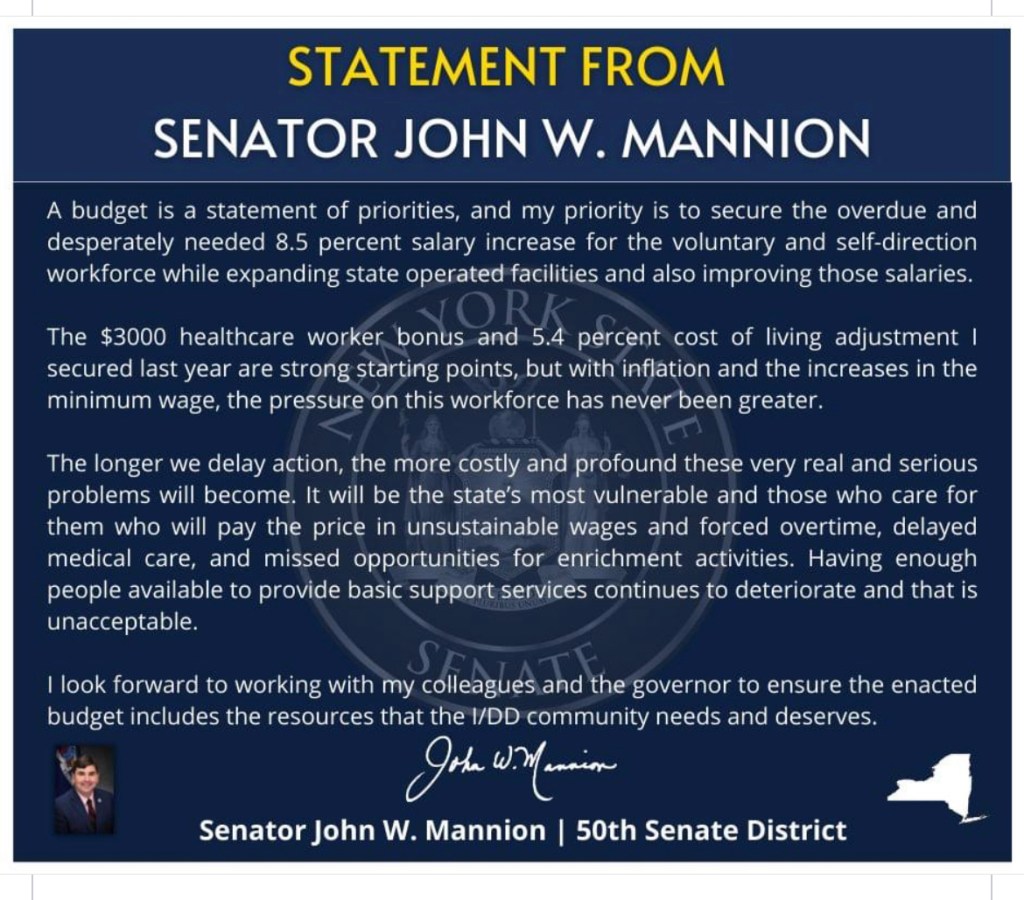

NYDA 2024 Executive Budget Statement

Statement from the New York Disability Advocates on Governor Hochul 2024 Executive Budget

Earlier this month, Governor Hochul outlined her administrations’ vision of the “New York Dream”, a government that will uplift all New Yorkers. Unfortunately, with the release of the Executive Budget today, the “New York dream” for people with intellectual and developmental disabilities (I/DD) and the individuals that provide life supporting services to them is not fully realized. 

Governor Hochul’s inclusion of a 2.5 % Cost-Of-Living-Adjustment (COLA) as part of the Executive Budget, simply does not provide the necessary resources to keep pace with the growing cost of providing services to people with developmental disabilities after a decade of cuts and lack of investment in these services. 

OPWDD’s own Strategic Plan, published in November, articulates Goal #1 as, “Improve the recruitment, retention and quality of the direct support workforce,” by “investing in the workforce.”  The system faces “a 35.6% turnover rate in the voluntary DSP workforce, a vacancy rate of 17.2% for full time positions, and a vacancy rate of 21.3% for part-time positions.”  

An adequate COLA increase is critical to address workforce turnover and increased operational costs. The Governor’s proposal to fund a COLA at 6% less than the system needs to sustain the status quo means that OPWDD will have some difficult decisions to make about where cuts to service delivery will happen for the 130,000 New Yorkers with I/DD and their families that rely upon them. 

With today’s announcement, we once again face the stark reality that nonprofit provider agencies for the I/DD community are overlooked and underfunded especially, considering OPWDD increased starting wages for their own workforce by 13%, who provide the same supports and services.  

Equity and support for all must make its way into the Governor’s and the Division of Budget’s dream for New York. Without that equity and support from our elected officials the New York Dream becomes a nightmare for the people with disabilities and their families, who are unable to get the resources they need to live their best lives. 

There are currently hundreds of people with I/DD waiting in hospitals, nursing homes, and psychiatric centers due to insufficient capacity in the OPWDD system. There are thousands more living at home with their aging caregivers who want to live independently with supports from OPWDD. This cannot be part of the New York Dream that Governor Hochul envisioned. 

New York lawmakers have a duty to serve all their residents, especially those who rely on them the most. We must work together to ensure that the I/DD community receives the proper recognition and resources it needs to build a sustainable future for the thousands of New Yorkers who need it. 

We are urging both houses of the New York Legislature to include an 8.5% Cost-Of-Living-Adjustment (COLA), as well as the establishment of a Direct Support Wage Enhancement (DSWE) to increase hourly pay for Direct Support workers in their respective one-house budgets. The fate of the I/DD community depends on it.

Governor Hochul’s 2023-2024 State Budget Proposal

Governor Hochul presented her 2023-2024 budget proposal today in the Red Room of the State Capitol.  Disability advocates were extremely disappointed that the Governor’s commitment “to serve all New Yorkers” and that this budget proposal “will do the hard things to lift up and support all New Yorkers” did not include New Yorkers with developmental disabilities, their families and the hardworking staff who support them.

Governor Hochul’s 2023-2024 (SFY ’24) budget totals $227 billion all funds spending (2.4% increase) and $125 billion state funds (2% increase) which includes:

  • $34.5 Billion in public education funding (a $3.1billion/10% increase) including a $2.7 billion/12.8% Foundation Aid increase.
  • 5% rate increase for hospitals, nursing homes and assisted living rates.
  • $24 billion in raining day reserves will be completed by the end of the current year — two years ahead of schedule.
  • $1 billion multi-year investment to transform New York’s mental health care continuum
  • $337 million for programs designed to prevent and reduce gun violence
  • $400 million to provide relief to New Yorkers experiencing high electric bills as well as lowering energy burdens through electrifications and retrofits.
  • Expands Medicaid coverage for 7.8 million low-income New Yorkers

Below are highlights of interest, to CP State Affiliates, from a quick look at the budget.  We will provide further details as we read all the budget bill language.

OPWDD

NYDA and all the disability advocates have been urging the Governor to include an 8.5% COLA & a $4,000 wage enhancement.  Unfortunately, the Governor’s budget included:

  • A 2.5% COLA for OPWDD, OMH, OASAS, OCFS, OTDA & SOFA
  • $0 wage enhancement
  • $2 million to establish a Statewide Ombudsman Program for individuals with developmental disabilities to “provide an independent advocate for individuals who are not able to speak for themselves and provide training and support to those who can make their own decisions to help them achieve greater independence.”
  • $11.7 million capital funding to develop Intensive Treatment Opportunity (ITO) Capacity units at the former Finger Lakes Developmental Center campus.
  • IBR Study -A two-year Independent Study on the Institute for Basic Research in Developmental Disabilities (IBR). 
  • An additional $15 Million to Develop Housing and expand independent living opportunities for individuals with IDD.
  • Flexibilities for Delegated Nursing Tasks – legislation to allow greater flexibility for the performance of certain nursing tasks by unlicensed employees in non-certified community-based settings.

SED

  • The Governor’s budget proposal includes a $3.1/10% billion overall increase and $2.7 billion/12.8% Foundation aid increase.
  • Zero growth or COLA was included for our schools, however, other than last year, our school’s growth has not been in the budget but has always been in the April 15 methodology letter.
  • $2.5 million for a rate setting study by SED to be presented to the Division of Budget by 7/1/2025

DOH

  • Zero Early Intervention increase
  • Zero clinic increase
  • $500 million in multi-year health care capital funding to drive transformative investment that support the State’s health care investments.
  • $500 million in multi-year capital grants to support investments in technological investment upgrades, including clinical tech and cybersecurity.
  • $967 million to complete consolidation of Wadsworth Laboratories’ five unconnected sites to one site on the W. Averell Harriman Campus in Albany by 2030.
  • $100 million to expand Medicaid coverage of preventative health services and access to primary care.
  • $157 million in New York State’s nursing homes and $9 million in New York’s assisted living providers to meet the staffing requirements
  • $60 million beginning in FY 2025 to expand the Medicaid Buy-In program so more New Yorkers with disabilities can work and still qualify for coverage.

OMH

A long-term, multi-year $1 billion investment to transform New York’s continuum of mental health care including:

  • $915 million in capital to develop new residential units, plus $127 million in annual operating costs.
  • $18 million in capital and $30 million annually to increase operational capacity for inpatient psychiatric treatment.
  • $60 million in capital and $122 million annually to expand outpatient services.
  • $27.5 million annually to improve post-discharge connections to services through the creation of 50 new Critical Time Intervention care coordination teams.
  • $30 million annually to expand mental health services in schools.

Barbara

Barbara Crosier

Vice President, Advocacy & Government Relations

Cerebral Palsy Associations of NYS

3 Cedar Street Extension, Suite 2

Cohoes, NY 12047

Phone:  (518) 436-0178

Cell:  (518) 424-3198

Fax:  (518) 436-8619

E-mail:  bcrosier@cpstate.org  

Logo

Description automatically generated

JUSTICE CENTER SUMMIT

SAVE THE DATES
 
April 18 – 19 and 25 – 26
2023 Justice Center Summit
 
The Justice Center for the Protection of People with Special Needs (Justice Center) announces it will be hosting the Justice Center Summit in April 2023. The event features several individual sessions covering policy updates, trends, prevention materials, and investigative tools. In addition, in-depth sessions on a variety of Justice Center programs will be available. The event is targeted for provider agencies under the jurisdiction of the Justice Center, individuals receiving services, families, peer advocates and other interested stakeholders. 
 
Click here for a summary of the session topics.
 
This summit will be conducted over four dates in April, 2023. There are two sessions per day and each session will last approximately 1.5 hours. You may register for one or all of the sessions. There is no charge to attend.


Tuesday, April 18
Session 1 – 10:30 am: Updates from the Justice Center
Session 2 – 2:30 pm: Overview of Pre-Employment Checks for Service Providers
 
Wednesday, April 19
Session 3 – 10:30 am: Technology Related Assistance for Individuals with Disabilities (TRAID)
Session 4 – 2:30 pm: Overview of the Surrogate Decision-Making Committee
 
Tuesday, April 25
Session 5 – 10:30 am: Lifecycle of a Justice Center Case
Session 6 – 2:30 pm: Justice Center Spotlight on Prevention: Best Practices for Responding to Medical Emergencies
 
Wednesday, April 26
Session 7 – 10:30 am: Overview of the Justice Center’s Individual and Family Support Services
Session 8 – 2:30 pm: Investigating Injuries of Unknown Origin
 
Register
 
Click on the Register button to sign up for individual sessions or all 8 sessions. Zoom links will be emailed prior to each session.
 
If you wish to request a reasonable accommodation to participate in any of these sessions, please contact Justice Center Training at jctraining@justicecenter.ny.gov.


Questions about registration? Contact WRI at info@wrisolutions.org
 
www.justicecenter.ny.gov


Opposition to Managed Care

January 2023

Dear Governor Hochul,

Happy New Year!  We welcome in the New Year with renewed hope for people with Intellectual and Developmental Disabilities (I/DD) and their families.  Our independent family and self-advocacy organizations continue to oppose Managed Care support services for people with I/DD, and are against extending NYS legislative authorization to continue further exploration when it expires this year.  The effort to pursue Managed Care for I/DD support services has already been extended for more than a decade.  We believe that too much time and money has already been wasted.    Extending the authorization will only result in delaying any effort to implement other needed changes to the service system.  

In November of 2022, OPWDD awarded a $1.44 million consulting contract “to study and evaluate how the implementation of managed care would assist in improving Long Term Services and Supports (LTSS) for people with I/DD.”  Previous studies to determine the effects of Managed Care for I/DD services show no evidence of cost benefit, improved access to services or quality of care in states that have attempted to transition.

  • A 2019 study funded by the Texas Legislature concluded: “While there are savings achieved on Long Term Services and Support claims, the amount of increased administrative expenditures outweighs savings from claims” (www.tinyurl.com/TX-IDD-Deloitte-Report )
  • The Medicaid and Chip Payment and Access Commission, a non-partisan group of experts concluded in 2021: “While much research has been conducted on whether Managed Care delivery systems result in better outcomes than fee for service (FFS), there is no definitive conclusion as to whether managed care improves or worsens access to or quality of care for beneficiaries  www.macpac.gov/subtopic/managed-cares-effect-on-outcomes )

Even more disconcerting is a NYS funded study by Deloitte that estimates the cost for initial implementation of Managed Care for I/DD services would be $200 million and would result in a similar increase in annual administrative costs. 

The money spent on studying managed care over the last decade might have been put to better use serving the needs of people with I/DD and the workforce supporting them.  Given the urgency of stabilizing and improving the workforce, increasing residential options, improving access and diversity as laid out in OPWDD’s Strategic Plan, this continued distraction over managed care comes with the even greater cost of failing to take needed action to implement these goals.  Please let the authorization to explore Managed Care expire so that stakeholders can immediately get to work accelerating changes that have a meaningful and positive impact on people’s lives.

Respectfully submitted on behalf of Families and Self-Advocates Representing People with Intellectual and Developmental Disabilities across New York State

CC:         Dr. James V. McDonald, Acting Commissioner Department of Health

               Kerri Neifeld, Office for People With Developmental Disabilities

               Jihoon Kim, Deputy Secretary for Human Services and Mental Hygiene

               Kim Hill, Chief Disability Officer

Kathryn Garcia, Director of State Operations

               Sandra L. Beattie, Division of Budget

               Senate and Assembly Disability Committee Chairs

               Senate Majority Leader

               Assembly Speaker

Senate and Assembly Legislators

HCBS Settings Rules

NYC FAIR
FAMILY ADVOCACY & INFORMATION RESOURCES
HCBS Settings Rules are set to begin on March 17, 2023
(Home and Community Based Services)

The Center for Medicare and Medicaid Services (CMS) requires all states receiving Medicaid waiver funding to implement these rules.
Medicaid funds help pay for these services

 CMS’s goal is to increase community integration and the settings rules will help get that accomplished 
OPWDD Informationhttps://opwdd.ny.gov/providers/hcbs-settings-toolkit
 
OPWDD Power Point* from 12/15/22 Webinar for providers: Click Here 
 Note: OPWDD is preparing a Plain Language VersionJoin Us January 26th, 7pm
Panelists:
Katherine Marlay, OPWDD Deputy Commissioner of Policy & Program Development
Megan O’Connor-Hebert, OPWDD Deputy Commissioner of Quality Improvement
Beth Haroules, Senior Staff Attorney of the New York Civil Liberties Union

 This Town Hall is a chance to learn about the changes: what they mean for people with Intellectual and Developmental disabilities, if they match the needs of the individual, what to do if they don’t and what can you do to protect your loved one
REGISTER TODAY To Register
Open Camera
Scan QR Code 

Or Click Here:

https://forms.gle/aYQyYdNQ39BMpEUL8
Ask Your Questions on the Form
 REGISTRATION REQUIRED
Confirmation will be emailed
If you do not receive an email, please email info@nycfair.org to verify your
email address

ZOOM Link will be emailed beginning 1/23/23 STAY CONNECTED:
LIKE NYC FAIR ON FACEBOOK
JOIN THE NYC FAIR FACEBOOK GROUP
FOLLOW NYC FAIR ON TWITTER
Contact info@nycfair.org with questionsTo ensure you remain on our email list, use the Icons Below to Forward and Post to Social MediaShareForwardVisit Our Website: www.nycfair.orgView this email in your browserFacebookTwitterWebsite
Stay Connected 

Thank You For Your Support
 Copyright ©  2022 NYC Fair, All rights reserved.

Know anything we don’t? Send Us an Email: info@nycfair.org

unsubscribe from this list    update subscription preferences 

 REGISTER TODAY To Register
Open Camera
Scan QR Code 

Or Click Here:

https://forms.gle/aYQyYdNQ39BMpEUL8
Ask Your Questions on the Form
 REGISTRATION REQUIRED
Confirmation will be emailed
If you do not receive an email, please email info@nycfair.org to verify your
email address

ZOOM Link will be emailed beginning 1/23/23 

ENYDDA Needs One Minute of Your Time!

It is important to the Steering Committee to get your feedback.  We want to be sure we are meeting your needs.  Please answer the following four questions by responding to enydda@gmail.com by January 15.  Thanks so much for your assistance and support.

1.  What is most convenient for you to attend meetings?

      In person or by zoom?

      Day or night?

      Please specify days/times

2.   What can we do to enhance meeting attendance and participation?

3.    What topics are of interest to you in order to assist with advocacy and obtaining information?

(e.g. Education, Adult Services, Eligibility, Self Direction, Housing/Residential, Budget Advocacy)

4.    Do you find the emails helpful that you receive from ENYDDA ?  If so, please explain.

NYC FAIRFAMILY ADVOCACY & INFORMATION RESOURCES

HCBS Settings Rules are set to begin on March 17, 2023
(Home and Community Based Services)

The Center for Medicare and Medicaid Services (CMS) requires all states receiving Medicaid waiver funding to implement these rules.
Medicaid funds help pay for these services
 
CMS’s goal is to increase community integration and the settings rules are to help accomplish that. 
 
OPWDD Informationhttps://opwdd.ny.gov/providers/hcbs-settings-toolkit
 
OPWDD Power Point* from 12/15/22 Webinar for providers: Click Here 
 Note: OPWDD is preparing a Plain Language VersionJoin Us January 26th, 7pm for this Town Hall to learn: What do these rules mean for people with Intellectual and Developmental disabilities.
Do they match the needs of the individual or not,
what to do if they don’t and what can you do to protect your loved one
REGISTER TODAY To Register
Open Camera
Scan QR Code 

Or Click Here:

https://forms.gle/aYQyYdNQ39BMpEUL8
Ask Your Questions on the Form
 REGISTRATION REQUIRED
Confirmation will be emailed
If you do not receive an email, please email info@nycfair.org to verify your
email address

ZOOM Link will be emailed beginning 1/23/23 Congratulations !to Senator John Mannion & Assemblymember Rebecca Seawright,

Chairs of the Disabilities committees in the NYS Senate & Assembly

Introduce yourself
Tell them why they need to be our champions in Albany
 
Senator John Mannion:
https://www.nysenate.gov/senators/john-w-mannion

Assemblymember Rebecca Seawrighthttps://assembly.state.ny.us/mem/Rebecca-A-SeawrightRALLY IN ALBANY

ANOTHER OPPORTUNITY TO HAVE

OUR VOICES HEARD
Graphical user interface, text

Description automatically generatedDETAILS COMING SOONSAVE-THE-DATE

New Integrated Community-Based Public Housing Opportunity

Public Comment Period Open on New Integrated Community-Based Housing Opportunity
Public Comment Open Until December 29, 2022
Dear Friends and Colleagues:
I am very pleased to announce that the draft OPWDD Funding Opportunity for Independent Living Letters of Support (FOFILLS) is now available for public comment. This funding round is being offered in response to many families and providers seeking an opportunity to be innovative in their approaches to integrated, community-based housing and to explore opportunities outside of established traditional paths. As this is a brand-new opportunity for our community and a new process for interested parties, we are seeking your review and input into the concept and the process.
Attached to this memo you will find a draft Request for Applications for the FOFILLS program. We are seeking public comment on this draft to help us refine our concept and process. This is not an actual opportunity to apply for support.
The public comment period will be open for 30 days, closing on December 29, 2022 and comments should be submitted to housing.initiatives@opwdd.ny.gov for review and consideration. After comments have been compiled, OPWDD will be releasing a response to public comments and an explanation of what changes we plan to make in response to the comments received.
This funding opportunity, referenced in the Administrative Memorandum ADM 2022-03, is a new process for reviewing long term funding requests under the OPWDD Housing Subsidy program for housing proposals that do not include State or New York City capital funding.  It is expected that the final application for these funds will be released in the late spring of 2023 (see timeline summary).
The FOFILLS application will be used to request groups of housing subsidies funded by the New York State Office for People With Developmental Disabilities (OPWDD) for individuals with intellectual or developmental disabilities whose living arrangement would be inclusive of four (4) or more individuals with intellectual or developmental disabilities where the proposed project is the development of an apartment complex, apartment style living, large single family home, or a group of collocated houses by an OPWDD approved provider.  A family or group of families/people with intellectual/developmental disabilities can apply only if they are affiliated with an OPWDD approved provider.
Although this funding has broad applicability, it cannot be used for the following:
Use of OPWDD’s housing subsidies through this program cannot be used to supplant existing funding for housing units with other rental subsidy funding, such as Empire State Supportive Housing Initiative (ESSHI) units or HUD Section 8 funded units.
This application cannot be used to request Housing Subsidies for proposed projects that receive any other form of state or federal supportive housing capital subsidy such as those funded by NYS Homes and Community Renewal (HCR). There will be two funding rounds through our Integrated Supportive Housing program (ISH) in the next year to support these projects (see timeline summary below).
Timeline SummaryFollowing is the general timeline for funding applications moving forward:
Late Spring each year – FOFILLS application for projects not seeking HCR or other state/federal capital funding.
Early Summer each year – ISH application for capital requests or housing subsidy only, to align with HCR’s Fall RFP. Support letters can also be used for HCR’s 4% as of right projects and NYC Housing Preservation and Development (HPD) projects.
Early Winter each year –ISH Application – subsidy only, to align with HCR’s Spring RFP. Support letters can also be used for HCR’s 4% as of right projects and NYC Housing Preservation and Development (HPD) projects.
I look forward to receiving your feedback as we work to finalize this new funding opportunity. 
Sincerely,
Kerri E. Neifeld
Commissioner