ENYDDA Needs One Minute of Your Time!

It is important to the Steering Committee to get your feedback.  We want to be sure we are meeting your needs.  Please answer the following four questions by responding to enydda@gmail.com by January 15.  Thanks so much for your assistance and support.

1.  What is most convenient for you to attend meetings?

      In person or by zoom?

      Day or night?

      Please specify days/times

2.   What can we do to enhance meeting attendance and participation?

3.    What topics are of interest to you in order to assist with advocacy and obtaining information?

(e.g. Education, Adult Services, Eligibility, Self Direction, Housing/Residential, Budget Advocacy)

4.    Do you find the emails helpful that you receive from ENYDDA ?  If so, please explain.

NYC FAIRFAMILY ADVOCACY & INFORMATION RESOURCES

HCBS Settings Rules are set to begin on March 17, 2023
(Home and Community Based Services)

The Center for Medicare and Medicaid Services (CMS) requires all states receiving Medicaid waiver funding to implement these rules.
Medicaid funds help pay for these services
 
CMS’s goal is to increase community integration and the settings rules are to help accomplish that. 
 
OPWDD Informationhttps://opwdd.ny.gov/providers/hcbs-settings-toolkit
 
OPWDD Power Point* from 12/15/22 Webinar for providers: Click Here 
 Note: OPWDD is preparing a Plain Language VersionJoin Us January 26th, 7pm for this Town Hall to learn: What do these rules mean for people with Intellectual and Developmental disabilities.
Do they match the needs of the individual or not,
what to do if they don’t and what can you do to protect your loved one
REGISTER TODAY To Register
Open Camera
Scan QR Code 

Or Click Here:

https://forms.gle/aYQyYdNQ39BMpEUL8
Ask Your Questions on the Form
 REGISTRATION REQUIRED
Confirmation will be emailed
If you do not receive an email, please email info@nycfair.org to verify your
email address

ZOOM Link will be emailed beginning 1/23/23 Congratulations !to Senator John Mannion & Assemblymember Rebecca Seawright,

Chairs of the Disabilities committees in the NYS Senate & Assembly

Introduce yourself
Tell them why they need to be our champions in Albany
 
Senator John Mannion:
https://www.nysenate.gov/senators/john-w-mannion

Assemblymember Rebecca Seawrighthttps://assembly.state.ny.us/mem/Rebecca-A-SeawrightRALLY IN ALBANY

ANOTHER OPPORTUNITY TO HAVE

OUR VOICES HEARD
Graphical user interface, text

Description automatically generatedDETAILS COMING SOONSAVE-THE-DATE

New Integrated Community-Based Public Housing Opportunity

Public Comment Period Open on New Integrated Community-Based Housing Opportunity
Public Comment Open Until December 29, 2022
Dear Friends and Colleagues:
I am very pleased to announce that the draft OPWDD Funding Opportunity for Independent Living Letters of Support (FOFILLS) is now available for public comment. This funding round is being offered in response to many families and providers seeking an opportunity to be innovative in their approaches to integrated, community-based housing and to explore opportunities outside of established traditional paths. As this is a brand-new opportunity for our community and a new process for interested parties, we are seeking your review and input into the concept and the process.
Attached to this memo you will find a draft Request for Applications for the FOFILLS program. We are seeking public comment on this draft to help us refine our concept and process. This is not an actual opportunity to apply for support.
The public comment period will be open for 30 days, closing on December 29, 2022 and comments should be submitted to housing.initiatives@opwdd.ny.gov for review and consideration. After comments have been compiled, OPWDD will be releasing a response to public comments and an explanation of what changes we plan to make in response to the comments received.
This funding opportunity, referenced in the Administrative Memorandum ADM 2022-03, is a new process for reviewing long term funding requests under the OPWDD Housing Subsidy program for housing proposals that do not include State or New York City capital funding.  It is expected that the final application for these funds will be released in the late spring of 2023 (see timeline summary).
The FOFILLS application will be used to request groups of housing subsidies funded by the New York State Office for People With Developmental Disabilities (OPWDD) for individuals with intellectual or developmental disabilities whose living arrangement would be inclusive of four (4) or more individuals with intellectual or developmental disabilities where the proposed project is the development of an apartment complex, apartment style living, large single family home, or a group of collocated houses by an OPWDD approved provider.  A family or group of families/people with intellectual/developmental disabilities can apply only if they are affiliated with an OPWDD approved provider.
Although this funding has broad applicability, it cannot be used for the following:
Use of OPWDD’s housing subsidies through this program cannot be used to supplant existing funding for housing units with other rental subsidy funding, such as Empire State Supportive Housing Initiative (ESSHI) units or HUD Section 8 funded units.
This application cannot be used to request Housing Subsidies for proposed projects that receive any other form of state or federal supportive housing capital subsidy such as those funded by NYS Homes and Community Renewal (HCR). There will be two funding rounds through our Integrated Supportive Housing program (ISH) in the next year to support these projects (see timeline summary below).
Timeline SummaryFollowing is the general timeline for funding applications moving forward:
Late Spring each year – FOFILLS application for projects not seeking HCR or other state/federal capital funding.
Early Summer each year – ISH application for capital requests or housing subsidy only, to align with HCR’s Fall RFP. Support letters can also be used for HCR’s 4% as of right projects and NYC Housing Preservation and Development (HPD) projects.
Early Winter each year –ISH Application – subsidy only, to align with HCR’s Spring RFP. Support letters can also be used for HCR’s 4% as of right projects and NYC Housing Preservation and Development (HPD) projects.
I look forward to receiving your feedback as we work to finalize this new funding opportunity. 
Sincerely,
Kerri E. Neifeld
Commissioner

DDPC Announces: The DDAC COVID-19 Report

Assessing NY’s Response to Covid-19

The NYS Developmental Disabilities Advisory Council (DDAC) was charged with preparing a report to the legislature assessing New York State’s response to Covid-19 for people with intellectual and developmental disabilities (IDD) and provide recommendations on improvements to better address the needs of people with IDD in future emergencies. The NYS Developmental Disabilities Planning Council(DDPC) was asked to assist the DDAC in the preparation of this report. This report was sent to the Governor and the legislature on November 17, 2022.

The DDPC engaged a significant number of stakeholders – over 2,000 self-advocates, parents and providers – to hear their stories of how the pandemic and the state’s response impacted them. Based on this vast amount of input, as well as extensive research and analysis of data, the DDAC’s findings include the following:

  1. People with IDD and their families living in the community felt largely ignored by the state in its response to COVID.
  2. The Office of People with Developmental Disabilities (OPWDD) COVID guidance often fell short and was not timely to address the needs of the providers and the people they serve.
  3. OPWDD’s guidance was often difficult to access and understand.
  4. Underserved communities were mostly overlooked by the state in response efforts.
  5. Non-profit providers were often not able to obtain necessary PPE from the state at the onset of the pandemic, putting staff and the people they serve at risk for COVID.
  6. Staffing shortage and program closures had a major adverse impact on individuals with IDD and caregivers.
  7. The hospital discharge policy may have inadvertently accelerated the spread of COVID for the IDD population living in congregate settings.
  8. People with IDD were initially denied necessary supports while hospitalized which impacted their ability to access appropriate treatment.

To improve the State’s response efforts to the IDD population. the DDAC’s recommendations include the following:

Create an Emergency Management Plan for the IDD community representing the racial, ethnic and linguistic diversity of NYS.

Require mandatory training for all first responders to appropriately respond to the unique needs of people with IDD.

Improve data collection and access to data during an emergency.

Address the chronic DSP workforce crisis by creating a task force to examine barriers and recommend actionable short and long term solutions.

Reduce reliance on congregate care setting for people with IDD by examining regulatory, financial and administrative barriers to offering more independent housing options.

Make telehealth, telemedicine and virtual programming permanent, ongoing services when it is appropriate and develop best practice guidance for providers.

NYS Developmental Disabilities Planning Council

99 Washington Ave
Suite 1230
Albany, New York 12210

Phone: 518-486-7505
Email: information@ddpc.ny.gov

Release of OPWDD’s 2023-2027 Strategic Plan

Dear Friends and Colleagues,

Governor Kathy Hochul today announced that the New York State Office for People With Developmental Disabilities has released our 2023-2027 Strategic Plan which will guide our agency as we work to strengthen supports and services for New Yorkers with developmental disabilities. The Strategic Plan is truly the work of hundreds, if not thousands of dedicated people from all across our state. It represents our collective goals and objectives for moving our service system forward and transforming it to better meet the changing needs of the people we serve, while prioritizing equity and ensuring sustainability.

I am so pleased to have spent the past year getting to know so many of you and have been fortunate to spend time with self-advocates, family members, providers and their staff, as well as many OPWDD team members in the regions statewide. Each and every person I met contributed to this important guiding document, and I hope you will find your voice within its pages.

Having collected initial input in 2021 through regional forums and targeted discussions, followed by feedback on our draft plan this year, we have honed all that we heard into three high level goals. Accompanying each goal are a range of supporting objectives and initiatives, projects and improvements that, with your support and collaboration, we will pursue over the next five years.

The Strategic Plan declares our top priorities, names the challenges we face and commits us to specific actions we will undertake together to improve the support we provide today and into the future. The plan we’ve released today is the result of many months of collaboration and dialogue. As you read it, I hope you feel excitement for all we want to accomplish.

Thank you for being part of the tremendous effort behind our 2023-2027 Strategic Plan. I look forward to our continued work to strengthen, grow and improve all we do in support of New Yorkers with developmental disabilities.

Sincerely,

Kerri E. Neifeld
Commissioner 

Video of NYC FAIR Town Hall


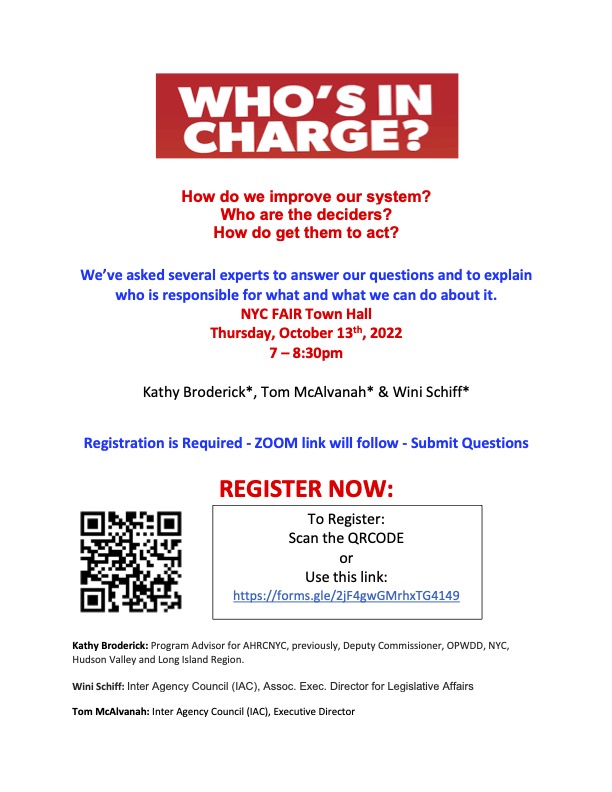
Who’s in Charge?
A Town Hall to Unpack the layersCouldn’t get on? View the Town Hall NOW!
We apologize for not having larger Zoom capacity
 
ADVOCATE EFFECTIVELY
YouTube Again https://www.youtube.com/watch?v=nKloTQ5K_8k Helpful Guides used during Town Hall:
Organizational Chart: Click Here:
New York Disability Advocates (NYDA) summary of their “ASK” for 2023-24 Budget. Click Here:

EDITORIAL

Albany Times Union, Sunday, October 2, 2022

It’s just heartless greed

Some insurance companies may be pocketing money meant for raises to alleviate a critical shortage of home care workers.

To comment: TULETTERS@TIMESUNION.COM

New York has a desperate shortage of home care workers to take care of sick, disabled, and frail people. Recognizing that dire situation, state lawmakers and Gov. Kathy Hochul put $7.7 billion in the state budget for wage increases to help retain and attract these vital employees.

But now it looks like hundreds of millions of dollars of that money may end up going to insurance companies that are keeping it for themselves.

https://digital.olivesoftware.com/olive/odn/albanytimesunion/Ads/ArticleInsert.htm

It’s a level of greed and opportunism in the face of a crisis that ought to shock the sensibilities of the governor and Legislature. And Attorney General Letitia James should look into whether there’s a civil or criminal case to be made here. Even it it doesn’t rise to criminality, it’s as offensive an abuse of public funds as the rampant fraud we witnessed in the false claims for unemployment benefits early in the COVID-19 pandemic.

As the Times Union’s Rachel Silberstein reports, the money was supposed to support minimum-wage increases of $2 an hour this year and $1 an hour next year. The increases were slated to start Oct. 1.

But some private insurance companies, in negotiations with home care agencies, are offering only 20 cents to 50 cents more an hour in reimbursement rates. The New York State Association of Health Care Providers says that as of last week, the vast majority of home care agencies reported no insurance companies even talking to them about raising reimbursement rates. Some even want to decrease rates.

The result, then, would be even worse than if the state had offered no new money at all. Because providers would have to pay more per hour but not be made whole by the insurance companies, they’d likely have to cut staffing and overtime pay and turn away clients insured by companies that won’t cover the wage hikes.

Certainly this sounds immoral, and it may not be legal. The state Department of Health says that under federal rules concerning how much money from premiums insurers and managed-care organizations have to spend on direct care, they can’t keep the state funds. The department intends to reinforce that message.

State leaders should deliver a message of their own — that keeping these public funds from getting to the workers is an egregious breach of trust. It’s not just about the pay, but about the health of an industry that so many vulnerable people depend on. Insurance companies are not just shortchanging the providers, they’re thwarting an important public health initiative.

Capital Region lawmakers — state Sen. Neil Breslin, D-Delmar, who heads the Senate Insurance Committee, and Assemblymen John T. McDonald III, D-Cohoes, and Phil Steck, D-Colonie, both members of the Assembly Insurance Committee, should call on their respective committees to convene and demand insurance executives come to Albany and explain themselves. And they should work with the Hochul administration to develop, if necessary, any new laws to force insurers to pass the money on, and retroactively pay anything they failed to do. And a penalty, if possible, might help drive home the point.

In the meantime, we offer some simple, clear, nonbureaucratic advice to the insurance industry: Do the right thing.

Aid for raises lost in shuffle

Article from Albany Times Union, Friday, September 30, 2022

Experts: All $7.7B from state for home care staff won’t reach paychecks

By Rachel Silberstein

ALBANY — Hundreds of millions of dollars in state funding set aside to raise the pay of home care workers are likely to end up in the pockets of private health insurance companies, industry experts say.

After years of campaigning for better pay, home care workers in New York state won $7.7 billion for wage increases in the state budget approved in April.

https://digital.olivesoftware.com/olive/odn/albanytimesunion/Ads/ArticleInsert.htm

The money is intended to help end New York’s worst-in-the-nation home care shortage. The funding is for a $3-per-hour minimum wage increase — $2 this year, $1 more next year. Workers and advocates are calling on the state to compel insurance companies to pay their fair share.

But private insurance companies, who negotiate reimbursement rates with home care agencies, are offering pay bumps as low as 20 cents or 50 cents per hour, according to offers from two insurance companies shared with the Times Union with the company name redacted.

According to Bryan O’Malley, executive director of the Consumer Directed Personal Assistance Association, talks with insurance companies can hardly be classified as “negotiations,” as home care agencies have little leverage.

“The only way we can force any kind of negotiation is if the Department of Health gets involved,” which is rare, O’Malley said.

According to a survey by the New York State Association of Health Care Providers conducted last week, 87 percent of home care agencies say they have had zero insurance companies reach out about the rate change. Of those that did hear from insurers, 61 percent reported being offered decreased rates. Most respondents said that the insurance companies are actively putting up roadblocks to even discussing a new rate.

“The only way we can force any kind of negotiation is if the Department of Health gets involved.”
— Bryan O’Malley, Consumer Directed Personal Assistance Association executive director

The home care raises are set to go into effect Oct. 1 — so if the state doesn’t step in immediately, private insurance companies could keep 80 percent of the money intended for low-income home care workers, advocates say.

The added cost to home care agencies could trickle down to workers in the form of reduced hours and overtime pay and turning away consumers with certain insurance plans, O’Malley said.

A state Department of Health spokesperson said that insurance companies, or managed care organizations, can’t keep the state funds due to federal “medical loss ratio” requirements. The medical loss ratio refers to the percentage of premium dollars that a health plan spends on medical claims and quality improvements versus money spent on overhead costs.

“The department informed plans that they should start coordinating with their provider network to make the necessary provider contract updated on Aug. 16 when we delivered the updated per hour amounts and rate schedules,” Monica Pomeroy said. “Additionally, on Sept. 12, the department organized a second webinar where we reiterated this information with MCOs and providers.”

The health department will keep reiterating its previously released guidance with health plans to ensure statutory compliance, she added. Providers are urged to connect with their contact at the Department of Health if they feel the plans are being unreasonable.

“The new per-hour values, which include all elements of the home care worker wage, are sufficient and actuarially certified to meet the new state statutory requirement as of Oct. 1, according to all the interactions and input we have had to date from both MCOs and providers,” Pomeroy said.

The New York Health Plan Association, a member organization of health care providers in the state, issued a statement Thursday calling on the state to “finalize rate packages to bring clarity to the process” of distributing the wage increases.

“Fair wage funding should be utilized to increase worker salaries, and health plans have been working diligently to adjust their rates to providers to reflect the changes included in the FY23 State Budget,” Eric Linzer, president and CEO of NYHPA, said in the statement. “Unfortunately, in some cases, the funding made available to health plans is not enough to support increases of the magnitude that providers are seeking, while in others some providers are not seeking the funds for workers but rather for profit.”

Debunking the Myths of Managed Care

Letter from ENYDDA, NYC Fair, DDAWNY,LIANDD, SWAN, GROW, SOYAN, NYADD and New York Self Determination Coalition

Dear Governor Hochul,

We are independent consumer and family advocates across NYS, and we want you to know: We remain opposed to Managed Care Support Services for People with Intellectual and Developmental Disabilities (I/DD). Managed Care for I/DD services will not save money, will not provide better care and will not address issues of equity and access to services.

The OPWDD service system faces many challenges. Growing demand, problems with supply and quality, and an on-going work-force shortage have amplified those challenges. Following more than a decade of system transformation and exploration, we are hearing a repeated message from some, that Managed Care for I/DD is the solution. This narrative creates the impression that a transition to Managed Care for I/DD services is inevitable.

Managed Care promises to improve access by leveraging its provider networks.  It promises to improve quality by instituting value-based payments and risk sharing.  It promises to bring more innovation, and many, many more promises.  These promises sound too good to be true for a very simple reason – they are too good to be true.

We reject the unproven aspirations of managed care for I/DD support services.  Instead, we want to focus on making improvements that have a direct and positive impact on people’s lives, starting now. As the exploration of Managed Care for I/DD services continues, we will continue to challenge it. Managed Care for I/DD services is not here, is not inevitable, and is not a good idea. This is the first of a series, ‘Debunking the Myths of Managed Care’.  Please reach out to any one of us to discuss this issue. 

Thank you,

Respectfully submitted on behalf of;

Families and Self-Advocates Representing People with Intellectual and Developmental Disabilities across New York State

CC:         Dr. Mary Bassett, Department of Health

                Kerri Neifeld, Office for People With Developmental Disabilities

                Jihoon Kim, Deputy Secretary for Human Services and Mental Hygiene

                Kim Hill, Chief Disability Officer

                Robert Mujica, Division of Budget

                Senate and Assembly Disability Committee Chairs

                Senate Majority Leader

                Assembly Speaker

Senate and Assembly Legislators