Attached please find a copy of the slide presentation done by Alber Pruett of OPWDD at our March 21, 2022 general membership meeting. This is a subject that will be impacting all of our family members with ID/D at some point.
Author: enydda
Special education preschool closes abruptly, leaving 25 children without services
Abilities in Wilton shutters doors on Friday amid staggering financial problems caused by the COVID-19 shutdown
Kathleen Moore, Albany Times Union
April 9, 2022 Updated April 10, 2022 6:25pm
WILTON – A special education preschool closed abruptly Friday, after the owner was threatened with eviction over unpaid rent from the coronavirus shutdown. Abilities served 25 special education children between ages three and four. There are only three special education preschools in the county, and the other two are full, with openings unlikely until September.
It’s a desperate situation for one family, who asked not to be identified to preserve their daughter’s medical privacy. She has a rare genetic disorder that is linked to severe developmental delays. “She showed a lot of regression during the breaks with speech,” her mother said. “What’s going to go on if she doesn’t go to school for the next two to five months? It will cause her delays to be significantly more.” And it’s not a straight-forward matter to teach her daughter those skills. But the masters-level therapists at Abilities had the training and experience to invent ways to help her learn.“ It’s going to be up to us to figure that out now,” her mother said.
The reasons for the closure were under dispute. The landlord and owner offered conflicting accounts. But the decision left school district officials and the Saratoga County Department of Health scrambling to find a way to get essential services to the children. Each child was determined to need an intensive, half-day special education preschool due to developmental delays. At school, they received speech therapy, and many also received occupational and physical therapy, to help with skills like walking up steps or holding a pencil. Most of the children were also approved to attend the school through the summer because therapists documented that if they missed one week of school, it took them two weeks to get back to the skills they had before the break. Not being in school for 10 weeks could lead to them losing half a school year’s worth of progress. Now they are facing a five-month gap.
As an alternative to preschool, therapists can visit children at their homes, but there’s a long waiting list for that, too. Saratoga County is taking the lead on looking for options. “They’re doing everything they can to identify solutions,” said Saratoga County spokeswoman Christine Rush. “It’s not an easy task. Meanwhile you have these families and kids who need services.”
Parents are furious with the lack of notice they got of the closure, which was announced via email five days before the special education classrooms closed. By state law, schools must give 90 days notice, in writing, with a plan for the “safe and orderly transition” of each student to a new facility that can provide the required services. That hasn’t happened.
Owner Valerie Keen said she was distraught at the demise of the school, which she opened four years ago. Until the pandemic, the school hosted programs for toddlers. But her dream was to have an inclusive preschool, with both special and general education students learning together. She opened the first inclusive classroom in September 2020. That went well, so she opened a second classroom last September. The classrooms hosted four classes: two in the morning and two in the afternoon.
Then, in October, the landlord served her with an eviction notice for $22,000 in unpaid rent during the shutdown. Landlord Dean Kolligian is a member of the Saratoga Springs school board. Almost all of the special education children at the preschool will attend the Saratoga Springs school district. Kolligian said his role as a school board member “has nothing to do” with his decisions regarding the preschool. He declined to be interviewed but offered a written statement
“Abilities continues to remain open and operating because we understand this IS about the children they serve. The decision to close that specific program was theirs alone,” he wrote. “We are in frequent communication with Abilities to attempt to find a resolution to this issue and will continue to do everything we can to work with them through these challenging times.”
The eviction could not be processed until January, after the moratorium on evictions ended. In the meantime, Keen said Kolligian offered, in writing, to forgive half the rent if she paid $11,000. She said she paid him in September and October, while also staying current with the rent. But that meant using the cash flow cushion she had in her bank account. She told him that might put her under, she said, because state and county funds for special education services typically arrive six weeks after the service. She needed the cushion so she could pay her therapists while waiting for the next check.
The newest group of students also needed more services, costing more money as she hired more therapists. She asked the state to increase her “provisional rate” as a new school, which was a per-day cost of $91.60 per child. Her actual daily cost was about $159 per child. But it became clear an increase could be years away. Between the lack of cash cushion, the six-week wait for pay, and the low rate, she began to realize she wouldn’t be able to make payroll.
At that point, in November, everyone took steps. Saratoga County issued two checks to her on an emergency basis, to get her money faster. Kolligian reduced her rent from $6,800 to $5,000. Keen stopped taking any pay. Her preschool director reduced her salary to minimum wage and her bookkeeper took a $3-an-hour pay cut. But it wasn’t enough. Last week, she had $56 in her bank account, seven days before she had to make a payroll of $23,000. She made payroll after payments came in, but she told the state that unless someone could authorize an immediate rate increase, she would have to close. “The state does not pay enough money to support these programs,” she said. State officials told her she had to file a 90-day shutdown notice. “I said, first of all, I don’t have 90 days,” she said. “I can’t pay my staff, the program has to shut down.” She calculated that if she dropped the special education students and the staff needed for them, she could continue the preschool for general education students through June. So she told all of the families that on Monday. Then she got another eviction notice. “I’ve been paying the rent! But they hired a litigating attorney to take us to court,” she said. “So now my gen-ed preschool is going to get kicked out.”
Parents have called her names, telling her that she made bad business decisions and should have told them about the financial problems earlier. She’s not angry about the criticism. She feels devastated too.“ This is my life’s work and it’s being completely destroyed,” she said. She does not plan to reopen the preschool. “I’m done,” she said.
Written By Kathleen Moore
Kathleen grew up in Glenville and now lives in Schenectady. She has covered the Capital Region for various newspapers since 2000, focusing on the interesting people who breathe life into their towns, villages and cities. She is now covering southern Saratoga County. You can reach her at Kathleen.Moore@timesunion.com or 518-918-5497.
.
Final Budget Includes Significant Investment In I/DD Field
April 8, 2022
From The ARC New York
The Governor and Legislature reached agreement on the New York State budget late last night, after extensive negotiations. This afternoon, the Senate and Assembly passed the Health and Mental Hygiene budget bill (A9007C/S8007C), which outlines the specific funding for our field, and realizes many of our initial advocacy priorities.
The Enacted Budget includes a 5.4% cost-of-living adjustment (COLA), expanded eligibility of the Statewide Health Care Transformation Program (SHCFTP) to include community-based I/DD providers, and changes in language so our clinical staff can access the Nurses Across New York (NANY) loan repayment program. Yesterday, Governor Hochul mentioned an agreement to include $1.2 billion in bonuses for essential healthcare workers. This is the same amount appropriated in her Executive Budget, which included bonuses of up to $3,000 for Direct Support Professionals. We expect language outlining the direct care workforce retention bonuses will be released later today.
The final budget reflects and expands on the significant investment originally outlined in the Executive Budget. This is by far the largest investment New York state has made in the I/DD field in over a decade. Following the release of the one-house bills, we shifted our ask to support the Assembly proposal to forgo workforce bonuses in favor of an 11% COLA, which we saw as the most straightforward and effective way to allocate the funds committed in all budget proposals. Although we did not achieve the 11% COLA as proposed in the Assembly one-house bill, we were successful with our initial request – and in securing recognition of the crisis we are facing and the need for substantial investment in the I/DD field.
This success is due in no small part to the ardent advocacy from The Arc New York family. Since last summer, we have held rallies, garnered media attention, engaged with our legislators, and sent more than 17,000 letters calling for significant and sustained investment in essential supports and services for New Yorkers with I/DD. Our voices have finally been heard.
With this budget, the Hochul administration and the legislature have demonstrated a commitment to the voluntary provider sector, our direct care workforce, and the individuals and families we support. These investments are only the start of a much larger conversation about how to adequately fund equitable wages for our dedicated workforce, and ensure sustained investment the New York’s system supports and services. Our fight isn’t over, but the landscape has shifted, and we will continue to raise our voices together to achieve lasting support and solutions.
We will continue to advocate for a DSP Tax credit, which was not included in any of the proposed budget. The Education, Labor and Family Assistance (ELFA) Article VII budget bill and Aid to Localities, Capital Projects, and State Operations appropriation bills have yet to be introduced. We will provide necessary updates as bills are introduced and budget language is analyzed.
On behalf of The Arc New York, we thank each of you for your advocacy and your tireless contributions toward realizing our shared mission to provide New Yorkers with disabilities the ordinary and extraordinary opportunities of life!
Rescinding of visitation guidelines
 |
Rescinding of Visitation Guidance
The COVID-19 infection rates for the people receiving services from OPWDD and our providers continue to decline. As a result, OPWDD is rescinding its COVID-19 Interim Visitation Guidance for Certified Residential Facilities that was issued on January 4, 2022.
Residential facilities with positive cases of COVID-19 should continue to adhere to the protocols contained in the document Management of Co-Circulation of Influenza and COVID-19 Infections, issued on October 20, 2020. In addition, all providers of services shall continue to require all staff, volunteers, contractors, vendors, visitors and individuals receiving services to wear appropriate face coverings, consistent with 14 NYCRR Section 633.26.
Please contact Susan Prendergast with any questions at: susan.b.prendergast@opwdd.ny.gov
Letter from the Statewide Advocacy Network of New York


BOCES DSP Workforce Development
A new Direct Support Professional (DSP) training program at BOCES, coordinated with the New York Alliance for Inclusion and Innovation (NY Alliance), will solve a massive, double-digit shortage of workers in the industry with career paths for adults.
The $155,800 grant announced recently will help low-income individuals who are unemployed or “under-employed” receive training through BOCES to become direct support professionals (DSPs). DSPs help people with disabilities navigate everyday life tasks, such as work, volunteer, live in their own home and go to doctor’s appointments.
“This initiative will produce qualified individuals who are skilled and ready to meet the workforce needs of the disability sector as direct support professionals (DSPs),” said President and CEO of the NY Alliance Michael Seereiter. “We are excited about the program and the new career paths it will create for students at BOCES – and the precedent it will set to help take this effort statewide.”
DSP training will become part of BOCES’ existing Certified Nurse Assistant, Home Health Aide, and Personal Care Aide (CNA/HHA/PCA)program, thus allowing program graduates to pursue four career paths
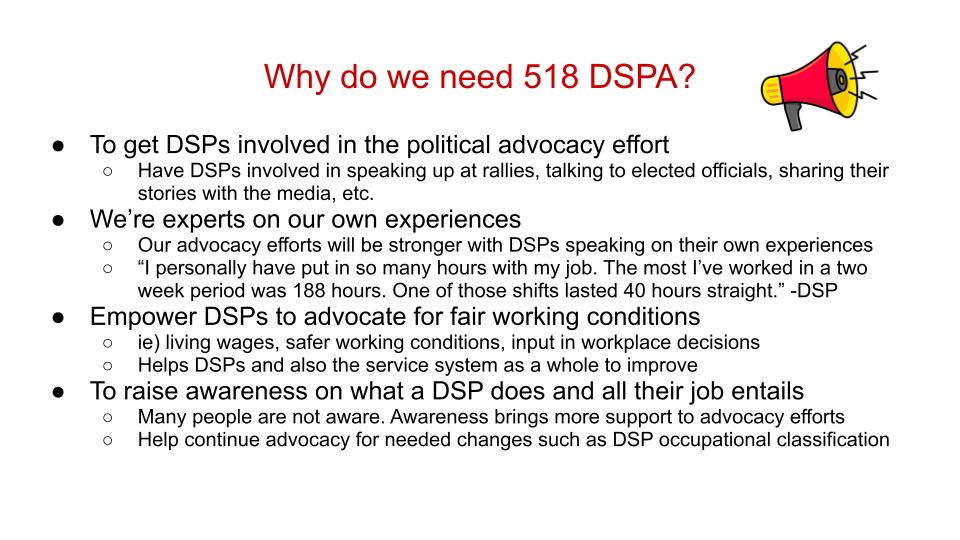
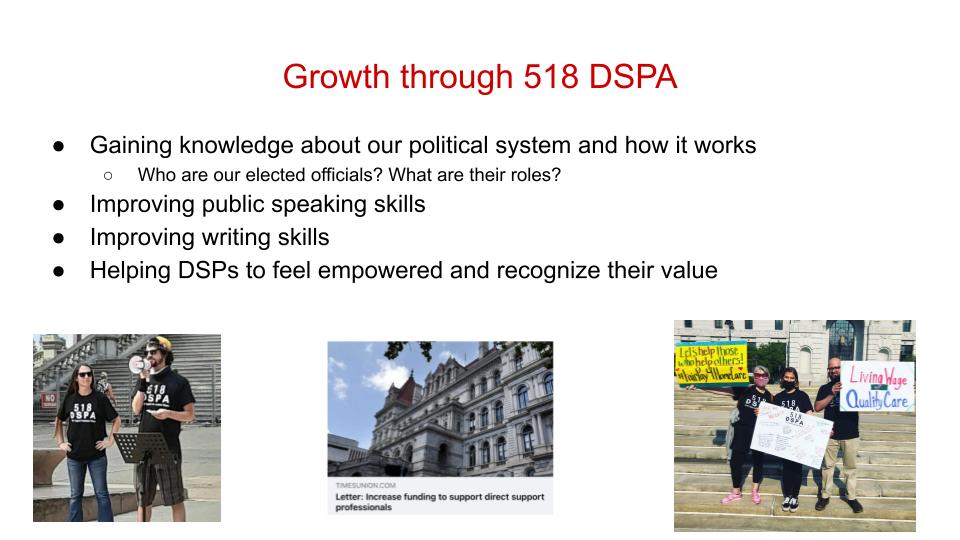
518 DSPA PRESENTATION


NYDA Lawsuit Successful
In a State of New York Supreme Court stipulation of dismissal without prejudice agreement reached between NYDA providers and NYS, the State has agreed to not retroactively implement their proposed IRA and day hab rate reductions which were scheduled to take place in 2020 (and moved to 2021). These reductions included the elimination of the IRA occupancy factor, the reduction in the number of IRA therapy days, and the reduction of retainer and therapy day hab payments.
The State has also agreed to file an amended Appendix K if needed to propose a delay to those provisions until six months after the end of the federal public health emergency declared by the DHHS.
Should CMS not approve the Appendix K amendment, the State has also agreed to not retroactively recoup any funds from providers as it relates to these proposed reductions for the period of time in which the rate cuts were not implemented.
This is at least a temporary win for the providers but they could face these reductions in the future as indicated above.
OPWDD Workforce Stabilization Supplemental Payments
F.A.Q’s On OPWDD Workforce Stabilization Supplemental Payments
Several of you have asked questions about the specifics of OPWDD’s Workforce Stabilization Supplemental Payments following our Technical Webinar that was held last month. We’ve created a Frequently Asked Questions (F.A.Q) web page to answer many of those questions.
A link to our webinar and even more information about Strengthening and Supporting our Direct Support Workforce can be found here: Supporting and Strengthening the Direct Support Workforce | Office for People With Developmental Disabilities (ny.gov)
We hope this information is helpful. Should you have questions about the Workforce Stabilization Attestation, contact COVIDAttestation@opwdd.ny.gov. For questions relating to the COVID Service/Vaccination Incentive Survey, please get in touch with us at COVIDSurvey@opwdd.ny.gov
 ENYDDA