OPWDD-NCCC Family Listening Sessions

This image has an empty alt attribute; its file name is image.png

Georgetown University to Host Family Listening Sessions

Do you have a family member with an intellectual or other developmental disabilities (IDD) who receives supports and services now, has received them in the past, or has been unable to access supports and services? OPWDD wants to hear from all families in New York State across diverse racial, ethnic, linguistic, cultural, and other identity groups. Your thoughts and experiences matter!

REGISTER NOW!

Georgetown University National Center for Cultural Competence (NCCC) is conducting listening sessions (on Zoom and by telephone) for families of persons with IDD. The listening sessions are intended to hear about your experiences in accessing supports and services:

  • based on your family’s cultural beliefs and practices,
  • in your preferred language, and
  • that are appropriate and fair for your family member with IDD.


Your experiences and insights are important. NCCC will listen to you and pass this information along to OPWDD. Your name will not be included in any of your comments. Sharing your thoughts and experiences will help OPWDD and its providers improve supports and services for persons with IDD.

To ensure accessibility, the sessions will be offered:


We understand the demands on your time. That’s why we’re offering sessions during the weekdays and on Saturdays to accommodate your schedules.

We appreciate the time you will devote to participating in a listening session. We will offer participants a $25 electronic gift card (one per family) to honor your time.

Space is limited! Register today and share with other families!

If you have any questions, please email us at OPWDDlistens-NCCC@georgetown.edu or call 202-784-0600.

REGISTER NOW!

For more information on the OPWDD-Georgetown University DEI initiative, visit:
https://nccc.georgetown.edu/opwdd/events.php

OPWDD Releases New Data on Developmental Disabilities Services

Dear Friends and Colleagues:

As part of my commitment to enhancing the agency’s transparency and being more responsive to stakeholder feedback, I am excited to share new, interactive, Medicaid data dashboards as part of this year’s annual release of information on services. For the first time, the Office for People With Developmental Disabilities (OPWDD) has added Medicaid expenditure data on OPWDD services and supports that can be broken out by region, type of service, type of self-direction being used, if applicable, and service provider. Different “data dashboards” provide information on total expenditures, average expenditures, and the use of services and can be sorted in a number of ways, depending on user interest. For example, you could look at information about services received by people in a particular region of the state or by people of a particular age group.

In addition to these interactive dashboards, we have redesigned our data webpages to make it easier to access the information and have released a new set of By the Numbers infographics that provide concise visual summaries of information about our services and supports.

These updates will help OPWDD to make information about our service system readily available and easy to understand for everyone. We remain committed to continually improving our ability to collect, analyze and share data about our service programs and sharing data that informs our policies and our ongoing work to improve the service system.

To view the new data resources, visit www.opwdd.ny.gov/data.

Sincerely,

Willow Baer
Acting Commissioner

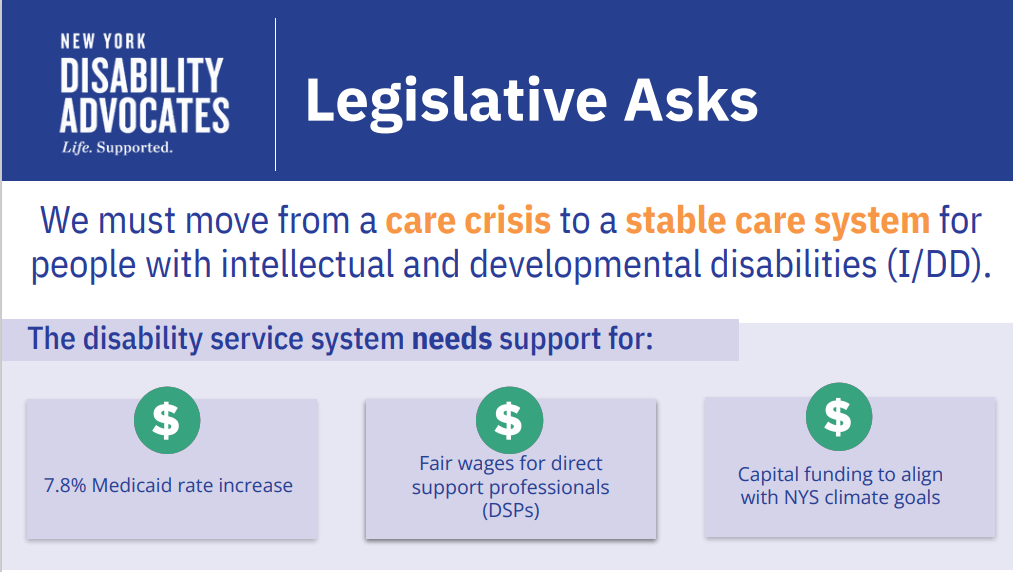
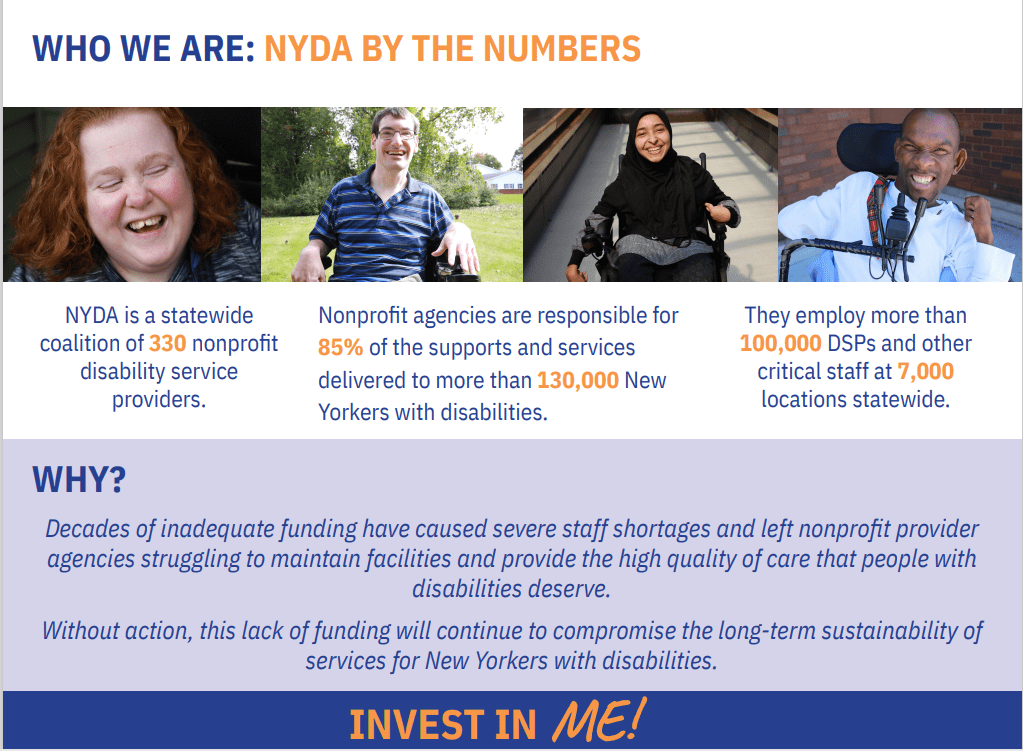
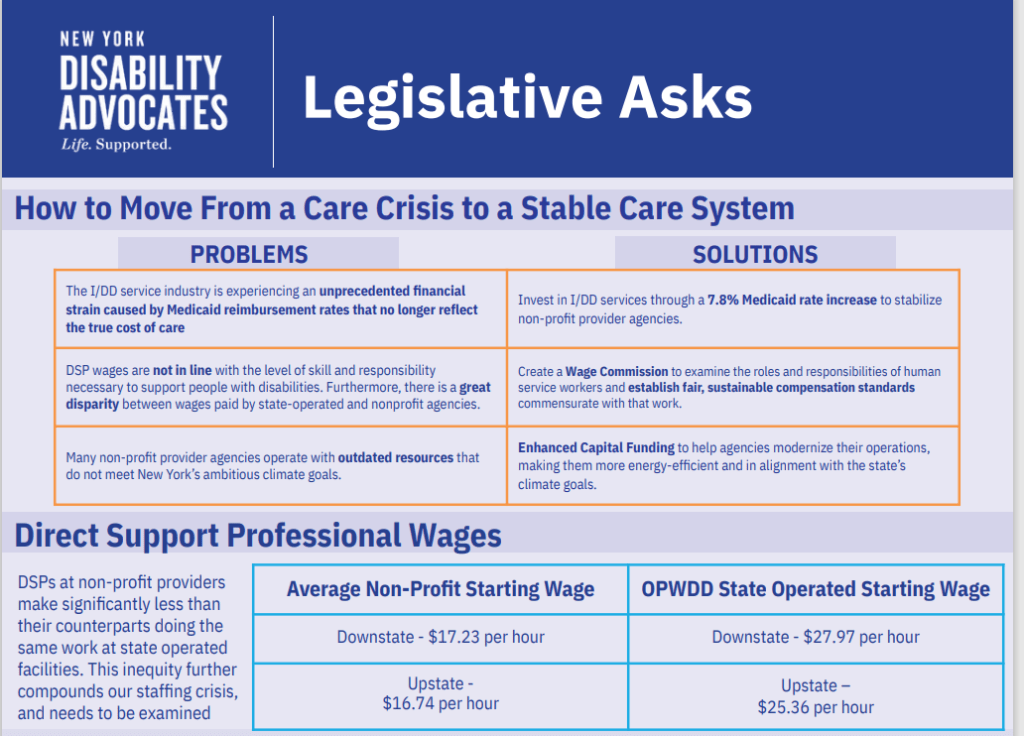
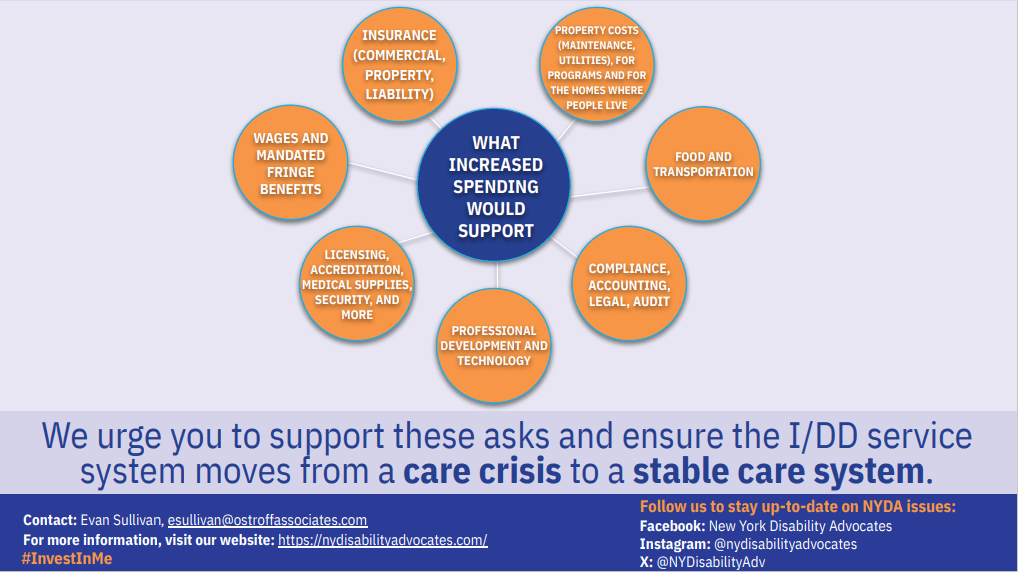
Tell the Governor & The Legislature: Invest in New Yorkers with Disabilities!

Join us in urging the Governor to invest in New Yorkers with disabilities and the people and agencies that serve them!
We are calling on her to include the following requests in the 2025-26 New York State Budget:Investment in I/DD services through a 7.8% Medicaid rate increase to stabilize non-profit provider agencies.Creation of a Wage Commission to examine the roles and responsibilities of human service workers and establish fair, sustainable compensation standards commensurate with that work.Enhanced Capital Funding to help agencies modernize their operations, making them more energy-efficient and in alignment with the state’s climate goals.
 We need YOUR voice in this fight. Click the button below and tell the Governor to invest in New Yorkers with disabilities!
Message the Governor NOW!
Thank you for being an advocate for people with disabilities. Consider joining the CP Family Group to stay up to date on disability issues and family supports.
Click the link below to log in and send your message:
https://www.votervoice.net/BroadcastLinks/H9wrLeLSS3nGqhGCJN2rPA

Click here to unsubscribe from this mailing list.

OPWDD Launches Videos Celebrating the Positive Impact of Hiring People With Disabilities

Dear Friends and Colleagues,

In honor of National Disability Employment Awareness Month, OPWDD is excited to share two new videos that highlight the positive impact of hiring people with disabilities: It’s Time to Employ Ability: Hiring People With Disabilities and Employing People with Developmental Disabilities: The Employer PerspectiveI hope you will appreciate the powerful messages in the videos and share them widely to promote a more diverse and inclusive workforce.

People with developmental disabilities are skilled, competent employees who add diversity and value to all kinds of businesses across New York State. Yet the employment rate for working-age New Yorkers with a disability is less than half of what it is for people without disabilities. We need to work together to bridge the gap between job seekers and employers and to bring more people with disabilities into the workforce.

Thanks to Governor Hochul’s commitment and support, we are making strides and increasing employment for people with disabilities. As part of New York’s commitment toward becoming an Employment First State, we are partnering with businesses that have already committed to hiring people with disabilities, and we’re excited to build more relationships that will benefit our state economy by strengthening the workforce, increasing diversity and broadening perspectives.

Today, to kick off the month, we are thrilled to sponsor New York’s 3rd Annual DREAM Symposium, hosted by Governor Hochul’s Chief Disability Officer, Kim Hill-Ridley. This incredible event celebrates the rights of people with disabilities and the value they bring to the workforce, matches prospective qualified candidates with employers and offers workshops that can help people prepare for and succeed in employment.

This month, and all year long, we urge businesses and employers in New York State to take our Employability Pledge and let everyone know you believe in the value of a diverse workforce and the rich contributions of employees with disabilities. All of us can help by patronizing the businesses that hire people with disabilities. Those that have signed our pledge appear on our EmployAbility Honor Roll

At OPWDD, I have prioritized bringing people with developmental disabilities into our workforce because I value their contributions to policy development and decision-making. Working together, I believe we can and will improve the number of people with disabilities working in our communities. Your help and support are invaluable to us. Thank you.

Sincerely,

Willow Baer
Acting Commissioner

Managed Care Assessment Completed

Over the past year and a half, outside consultant Guidehouse independently examined OPWDD’s developmental disabilities service system and evaluated whether using managed care to pay for OPWDD services could benefit the system and improve outcomes for people. As part of this study, Guidehouse talked extensively with stakeholders – both within New York and beyond – to understand current supports for people with developmental disabilities, their concerns, and what they, their family members, and service providers think about moving to a managed care payment model for services. Earlier this month, OPWDD released the Final Report and Recommendations that resulted from the Guidehouse assessment.

Based on its findings, Guidehouse does not recommend that OPWDD make a full transition to managed care. The Final Report does, however, offer several suggestions and considerations that OPWDD will evaluate, including the potential for using value-based payment structures to better integrate the physical and behavioral health care for people with developmental disabilities and improve access to specialized care.

Read the full Guidehouse Final report, along with the plain language report summary now on our managed care assessment webpage.  You can send any feedback on the report to ARPA.Inquiry@opwdd.ny.gov

People First News, September 2024

Dream image

Join Us on Tuesday, October 1st

Join OPWDD for New York State’s 3rd Annual DREAM (Disability Rights & Employment Awareness Month) Symposium on Tuesday, October 1, hosted by Governor Hochul’s Chief Disability Officer Kimberly Hill Ridley. The event will be held at the Empire State Plaza’s Concourse from 8 am until 5 pm.

OPWDD is proud to be one of the state agencies sponsoring this symposium which celebrates the value people with disabilities bring to the workforce and provides an opportunity to match prospective qualified candidates with employers.

This year the Keynote Speaker will be Mindy Scheier, Founder and CEO of Runway of Dreams.

There will be an in-person job fair and workshops on a range of topics pertaining to employment. 

Whole Person Supports-Call for Volunteers

All – This is a follow-up reminder to anyone interested in providing input in a more structured way to the Coalition for Whole Person Supports. We are especially interested in input from self-advocates, families, and providers. There are two groups that will be providing more formal input: the advisory group and the steering group. The latter will take input from the advisory board and may eventually produce recommendations for models that support more whole person care. Volunteering does not mean you are signing on to a position, but we do want you to be open to models that are more holistic in their approach to supporting people with I/DD.  Both groups will be reviewing various models and prototypes of supports and the steering committee may eventually develop recommendations for change. Volunteering for either group will require about a half-dozen hours of your time between mid-October and the end of the calendar year for meetings and conversations.

If you are interested, please complete this form by next Friday, October 4th

Selection Process: A smaller group, consisting of at least 1 self-advocate, 1 parent, 1 provider, and 1 knowledgeable but un-impacted party will be convened to help with the selection process for both the steering group and advisory group. Below is more detail and a proposed overview of each group. Once members for each group are selected, the members of each group will be allowed to further refine and shape their roles and procedures. The following is our proposal for the functions of each group:

Proposed Functions of Steering Committee

  1. The steering committee will develop and vote to finalize the following core components of the coalition:
    • Key principles of the Coalition for Whole Person Supports
    • Coalition administrative matters, such as the management of the website
    • Oversee the work of the coalition related to policy analysis and partnerships with other organizations
  2. The steering committee will also be responsible for the development of policy recommendations to be provided to NYS that primarily focus on the models of integrated care that the coalition reviews. 
  3. Serve as representation for the providers, individuals, and families within the region they are nominated from by aggregating ideas and feedback to include in the deliberation process and recommendations.

Proposed Functions of Advisory Board

  1. The advisory board will provide input to the steering committee on various policy recommendations and whole person care models reviewed by the coalition. This input will include:
    • Support for the model(s) and contextualizing the models with the real-world issues the model(s) may solve
    • Opposition to the model(s) along with justifications for why the model(s) will present a challenge for the system
    • Implementation considerations for each model and policy recommendation under consideration
  2. The advisory board will also raise issues in the field that the coalition should address and consider, as they pertain to whole person care. This will include the identification of additional models for review and analysis by the coalition including the entire advisory board and the steering committee 

Again – Thank you for interest and willingness to consider serving on one of these groups. We hope these efforts, at minimum, help to further a conversation about ways to improve supports with the end goal being supports and services that better meet all the needs of individuals with I/DD.

Courtney Burke
Sachs Policy Group

Justice Center Training on Abuse Prevention Resources

Justice Center Abuse Prevention Resources

This 60-minute webinar provided by Justice Center Prevention and Quality Improvement staff offers an overview of abuse prevention resources available on the Justice Center website.

Thursday, October 10, 2024 

11 a.m. – 12 p.m.

Register Here

Davin Robinson

She/Her/Hers

Deputy Director

Outreach, Prevention and Support

Justice Center for the Protection of People with Special Needs

161 Delaware Avenue, Delmar, New York 12054

518-549-0223 | davin.robinson@justicecenter.ny.gov

www.justicecenter.ny.gov