ENSURING THAT PEOPLE WITH INTELLECTUAL AND DEVELOPMENTAL DISABILITIES HAVE A VOICE, EVERY AND ANY DAY
Dear Colleagues and Friends,
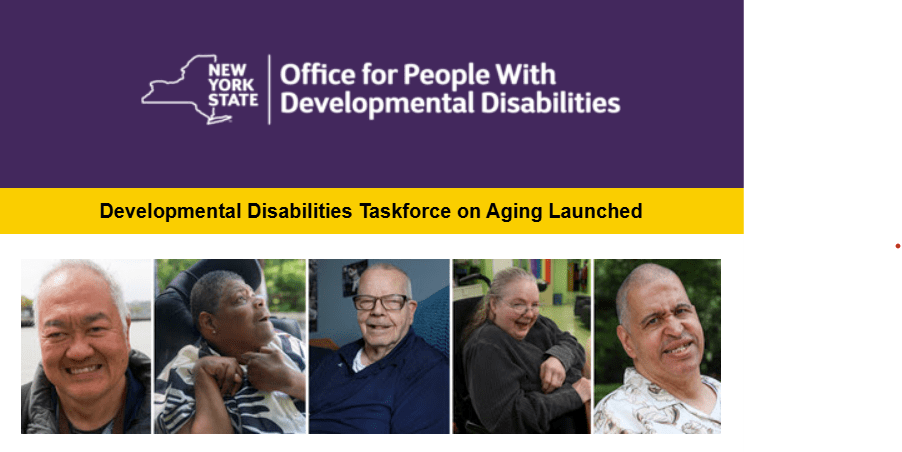
I am pleased to share that OPWDD recently convened its inaugural meeting of the Developmental Disabilities Taskforce on Aging—a collaborative initiative between my office and the Developmental Disabilities Advisory Council (DDAC).
This taskforce brings together leaders, self-advocates, families, and subject matter experts to develop actionable recommendations that address the evolving needs of New Yorkers with developmental disabilities as they age. We recognize that this population often face unique challenges related to aging in place, healthcare access, and overall quality of life.
At OPWDD, we are committed to supporting people to live as independently and meaningfully as possible through every stage of life. As people with developmental disabilities live longer, healthier lives, we’re now faced with the opportunity—and responsibility—to adapt a service system that was not originally designed to support the complexities of aging. It’s a good problem to have, and one we are eager to solve.
We are grateful to have the partnership and insight of experts in aging, our colleagues at DDAC and, most importantly, the voices of families and people with lived experience. With this collective wisdom, I am confident we will shape innovative and effective strategies to enhance how we support people with developmental disabilities as they age—strengthening our system and improving lives across New York State.
With Gratitude,
Willow Baer
Commissioner


Dear Friends and Colleagues,
As I travel around the state, meeting with self-advocates, family members of people with disabilities, and our not-for-profit providers, I am overwhelmed by the fear and uncertainty you are experiencing about the federal cuts to Medicaid and other vital services and the impact it will have on your lives and on your businesses. I share your deep concern over the recently signed “Big Beautiful Bill,” which will decimate New York State’s safety-net healthcare system and is project to result in 1.5 million New Yorkers losing their health insurance coverage and 300,000 losing their SNAP benefits.
While the federal bill makes little change directly to the developmental disabilities services system, OPWDD relies on $7 billion from the Medicaid program annually to fully support more than 130,000 New Yorkers with developmental disabilities. We know that federal cuts of this magnitude will impact the people who receive our services, their families, direct support workers and providers of services, making it even harder to access medical care and in the form of lost benefits, such as SNAP and HEAP.
These edicts from Washington remain front-and-center for New York, with Governor Hochul committed to protecting New Yorkers. At the same time, OPWDD continues to move forward with our goals to increase independence and inclusion for people with developmental disabilities. This last state budget saw the single largest increase for OPWDD services to date, an increase of 9%, for a total budget of $13.1 billion. This included a 2.6% targeted inflationary increase for non-profit providers, and an historic $850 million investment in funding for our not-for-profit providers to continue to increase salaries for our vital frontline workers.
New federal cuts undermine our ability to provide the greatest quality support for people with developmental disabilities, removing the very safety net health services and benefits people with developmental disabilities rely on for physical wellness and safety in the community. Our resolve and our advocacy for the disability community, however, will only continue to grow. I will keep you informed about any changes or impacts to our system as we chart a path forward together. You are not alone in this: our community stands together.
Sincerely,
Willow Baer, Commissioner


OPWDD is pleased to invite you to one of our 2025 Strategic Planning Forums.
Focused on the 2023 – 2027 OPWDD Strategic Plan and the agency’s progress to date, these forums are an opportunity for you to learn more about the agency’s work, tell us about your experience, and to share your thoughts and ideas for the future.
We hope to hear from self-advocates, families, and providers from a variety of backgrounds and from across the state at the forums.
Each forum will include:
Click a link to tell us you’ll be joining at one or more of the following events:
ASL and Live Interpretation available upon request.
We hope that you’re able to join us and look forward to hearing from you.

On May 9, Governor Hochul announced passage of the Fiscal Year 2026 State Budget. This final Enacted Budget represents agreement between the Governor and the two houses of the state Legislature, the Senate and the Assembly.
Making New York More Affordable: Nearly $5,000 Back in the Pockets of Working Families

Inflation Refund
Middle-Class Tax Cut
Middle-Class Tax Cut
Child Tax Credit
Access to Child Care
Universal School Meals
With this budget, Governor Hochul has made clear her commitment to families – including those of people with developmental disabilities and hardworking New Yorkers like our direct professionals whose support is so essential to our system. I was honored to have a few of our Direct Support Professionals beside me at the Governor’s State of the State Address this year when the Governor announced she’d seek to deliver the largest middle-class tax cut in more than 50 years. And Governor Hochul delivered in this budget with nearly $1 billion in tax relief for New Yorkers. To fight back against inflation, this year’s budget includes New York’s first ever inflation refund, which will send checks up to $500 to families making up to $300,000 per year. Governor Hochul has also expanded the state’s child tax credit up to $1,000 annually per child under four and up to $500 per child aged four to 16.
Beyond these common-sense cost-saving measures, New York’s Enacted Budget holds promising wins for our frontline workforce, while increasing health equity and modernizing research capabilities for people with developmental disabilities.
Providing Relief to Nonprofit Provider Agencies
2.6% Targeted Inflationary Increase, the Fourth Consecutive Increase Totaling Nearly $1.4 Billion
$850 Million in Updated Reimbursement Rates for Residential and Day Service Providers Meant to Increase Wages for Frontline Workers
The Governor’s Enacted Budget continues the four-year trend of inflationary increases for New York’s frontline workers at 2.6%. In addition to this increase, the Governor has extended the nearly $850 million in updated reimbursement rates for non-profit residential and day service providers to allow them to offer more competitive wages for frontline workers, ensuring better retention, fewer staffing vacancies, and a better quality of life for people with developmental disabilities. We’re already hearing about the positive impact on providers for hiring and retention.

We know that access to healthcare is not equal for all New Yorkers. That’s why we’re happy to announce that this year’s budget includes $25 million to create Regional Disability Health Clinics across the state to improve access to health care and resulting health outcomes for people with developmental disabilities.
$75 Million to Modernize OPWDD’s Institute for Basic Research in Developmental Disabilities
The Enacted Budget also includes $75 million to modernize the Institute for Basic Research in Developmental Disabilities, OPWDD’s research arm.
New Funding to Establish a Genomics Core Facility
This investment – the largest in IBR’s history – will establish a Genomics Core Facility to better understand genetic defects underlying people’s disabilities.
New Funding to Create a “Center for Learning” on the former Willowbrook State School Property
his funding will also reimagine the former Willowbrook State School property into a “Center for Learning,” recognizing the importance this site had in sparking New York State’s disability rights movement and influencing the developmental disabilities delivery system across the nation.
More Tax Credits for Businesses that Hire People With Developmental Disabilities

Governor Hochul knows that employment open doors for everyone. This year’s Enacted Budget continues to build on New York’s Employment First initiative by more than doubling the maximum tax credit for businesses that hire people with disabilities from $2,100 to $5,000. This significant increase will not only benefit people with developmental disabilities who want to work but also the businesses that choose to offer them that opportunity.
READ MORE ABOUT NEW YORK’S ENACTED BUDGET HERE

Dear Friends and Colleagues,
I am incredibly honored and humbled to have been nominated by Governor Hochul, and confirmed earlier today by the New York State Senate, as the Commissioner of the Office for People With Developmental Disabilities.
For the last year I have traveled across the state visiting programs, clinics, and homes, and meeting with self-advocates, families, direct support staff, agency executives and community partners. I have heard about what is working well in our system and where there may be opportunities for improvement. The insight I gather from hearing from all of you helps to inform agency policy and the evolution of our work at OPWDD.
It is in response to your feedback that I launched a new Office of Advocacy this year, which employs several people with lived expertise in having a developmental disability. This team helps inform the work of the agency, by sharing their daily experiences in navigating the service system, as we evaluate policy development and implementation. The Office also supports people with developmental disabilities and their families in advocacy throughout the state.
Additionally, understanding the struggle of our non-profit sector led to an historic $850M investment in our certified residential and site-based day service providers, making funding available for increased wages for front line staff in order to enhance sustainability and access to these vital services. This investment complements four back-to-back cost of living or inflationary increases Governor Hochul has invested in the OPWDD non-profit sector over the last four budget cycles.
Feedback from advocates about how hard it was to access quality health or dental care led to the rebuilding of the OPWDD Dental Task Force, a renewed focus on people with developmental disabilities who are aging, and this year’s $25 million investment to create Regional Disability Health Clinics with increased capacity to serve people with developmental disabilities. A $75 million investment in OPWDD’s Institute for Basic Research in this year’s enacted budget will also modernize the facility and add a genomics lab to provide nation-leading research into the role that genetics plays in people’s diagnoses.
Finally, I am excited to work with some of the field’s staunchest advocates to create a Center for Learning on the Willowbrook State School Campus to honor the people who lived there and their families who exposed the atrocities that occurred more than 50 years ago.
As your Commissioner, I will continue to honor the voices of self-advocates, family members, and marginalized communities in OPWDD’s work. I am grateful to live and serve in New York State and I am committed to improving the experience that people with disabilities, their families, and our providers have with our system.
While the current federal climate is uncertain, we will be advancing strategies that impact people’s lives for the better by overhauling our residential programming to increase efficiency and choice; conducting regular listening sessions for families; building upon our outreach efforts to marginalized communities; creating a Commissioner’s Taskforce on Aging to recommend strategies to assist aging New Yorkers with developmental disabilities; cultivating partnerships to encourage more employment of people with developmental disabilities and continuing our statewide campaign to elevate the role of direct support professionals to encourage hiring and retention.
I am so grateful for the trust of Governor Hochul and the faith of the New York State Senate to serve in this important role and I look forward to continuing to work together for the people we love.
Sincerely,
Willow Baer
Commissioner

Dear Friends and Colleagues,
I am happy to share that the 800-page Care Coordination Program Evaluation report and Executive Summary is now available for review and can be found on OPWDD’s website, along with a plain language version, which will be translated into multiple languages. OPWDD chose the American Institute for Research Inc. (AIR) in April 2023 to evaluate the effectiveness of care management services delivered through OPWDD’s seven Care Coordination Organizations (CCOs). This review and AIR’s recommendations will help OPWDD and the CCOs understand how we can improve the quality and effectiveness of care coordination and the outcomes for people who receive care management services.
The review continues and builds upon the partnership between OPWDD and the CCOs to improve quality and effectiveness through a variety of collaborative activities already underway. The evaluation examined several important aspects of the CCO program such as its impact on overall health and wellness of people being served, how well the program is meeting the needs of people from diverse and/or complex backgrounds, how the program interacts with service systems beyond the developmental disabilities system and the effectiveness of its health information technology. It identifies systemic challenges that are impacting the program’s effectiveness and makes recommendations for improvements.
The in-depth review includes input from self-advocates, parents and caregivers, developmental disability providers and non-developmental disability providers, as well as from the CCOs and Care Managers themselves. In the final report, AIR identifies 67 recommendations for consideration by both CCOs and OPWDD. In fact, some of the recommendations provided by AIR are already underway between OPWDD and the CCOs.
As we review these recommendations, OPWDD continues to work with our CCO partners to deliver the most person-centered support to drive improved health and quality of life outcomes for New Yorkers with developmental disabilities.
You can read the report and its recommendations here Care Management | Office for People With Developmental Disabilities. Thank you to everyone who shared your experience as part of this review process.
Sincerely,
Willow Baer
Acting Commissioner

Dear Friends and Colleagues,
As OPWDD continues to focus on providing a continuum of support throughout a person’s lifespan, we recognize that the needs of an aging population with developmental disabilities can be complex. Supporting ways for people to age with dignity in their communities is critical and we are committed to supporting this ongoing quality of life.
To build upon New York State’s recent work on the Master Plan for Aging, I am hereby establishing a Commissioner’s Taskforce on Aging to develop actionable recommendations to address the increasing needs associated with aging for people with developmental disabilities in New York State.
The taskforce will be a time-limited subcommittee of the Developmental Disabilities Advisory Council (DDAC) and will be co-led by a member of the DDAC and my office. Membership will include subject matter experts in health, aging, housing, and developmental disabilities, and will include self-advocates, family members, developmental disabilities providers, and Care Coordination Organizations, as selected by the Taskforce chairs. Questions may be sent to DDAC@opwdd.ny.gov.
I look forward to working with this group to identify best practices that are responsive to the needs of aging New Yorkers with developmental disabilities and of those who support them.
Sincerely,
Willow Baer
Acting Commissioner