
Action needed to submit comments to the U.S. Department of Labor Regarding 14(c)

Dear Together for Choice Members and Friends:
 
On December 3, the U.S. Department of Labor announced a new proposed rule that would phase-out certificates issued under Section 14(c) of the Fair Labor Standards Act.  Section 14(c) permits the payment of special wages to individuals with disabilities who are unable to work as productively as a non-disabled person performing the same task.  The Department of Labor is accepting comments on its proposed rule through January 17, 2025.   It is critical that we submit as many comments as possible opposing the proposed rule.  Without Section 14(c) certificates individuals with the most significant intellectual disabilities will be unable to obtain employment.
 
Section 14(c) of the Fair Labor Standards Act has been in existence for over 85 years.  The purpose of Section 14(c) is to help individuals with disabilities to obtain employment.  No one is forced to work at 14(c) wages.  Therefore, the statute preserves choices for our loved ones; it preserves their civil right to choose the employment setting that best suits them. 
 
It was important that the Department of Labor hear from the families that would be affected by the phasing-out of 14(c) certificates. The Department needs to understand that eliminating Section 14(c) certificates will mean the loss of employment for men and women with significant intellectual disabilities, like our loved ones.  The Department is proposing a “one-size-fits-all” rule that will have a devastating impact on the more than 65,000 men and women who rely on Section 14(c) certificates. 
  
Therefore, please submit your comment to the U.S. Department of Labor BY JANUARY 17, 2025.
 
Comments can be submitted electronically or by mail.  Please follow the instructions below:

Electronic Comments: Submit comments at https://www.regulations.gov/document/WHD-2024-0001-0001.  Click the Comment button.  Where it says “Start typing comment here,” click and type your comment.

Mail Comments: Address written submissions to: Division of Regulations, Legislation, and Interpretation, Wage and Hour Division, U.S. Department of Labor, Room S-3502, 200 Constitution Avenue NW, Washington, DC 20210.

Thanks,
 
Scott M. Mendel
Chairman, Together for Choice
Tell the Governor & The Legislature: Invest in New Yorkers with Disabilities!

Join us in urging the Governor to invest in New Yorkers with disabilities and the people and agencies that serve them!
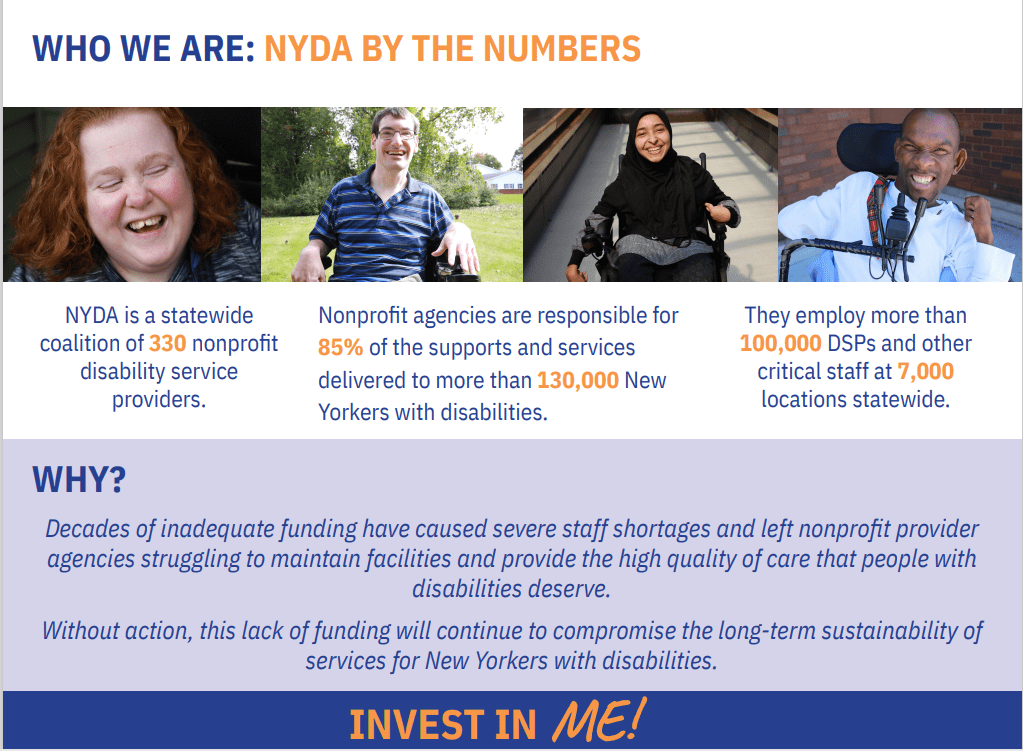
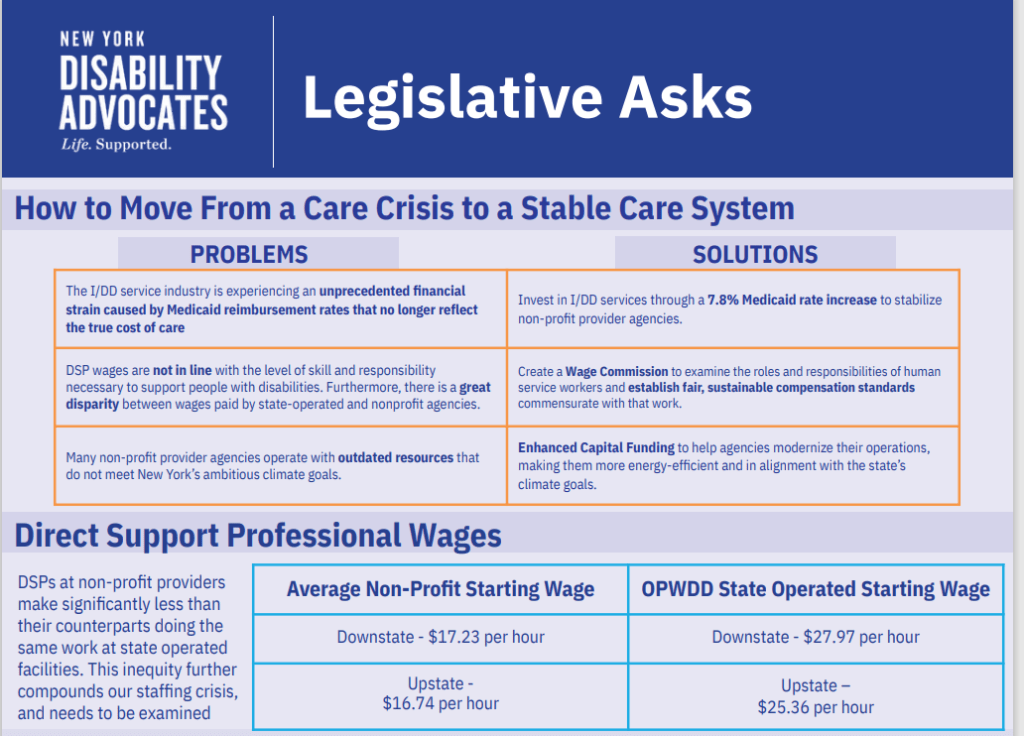
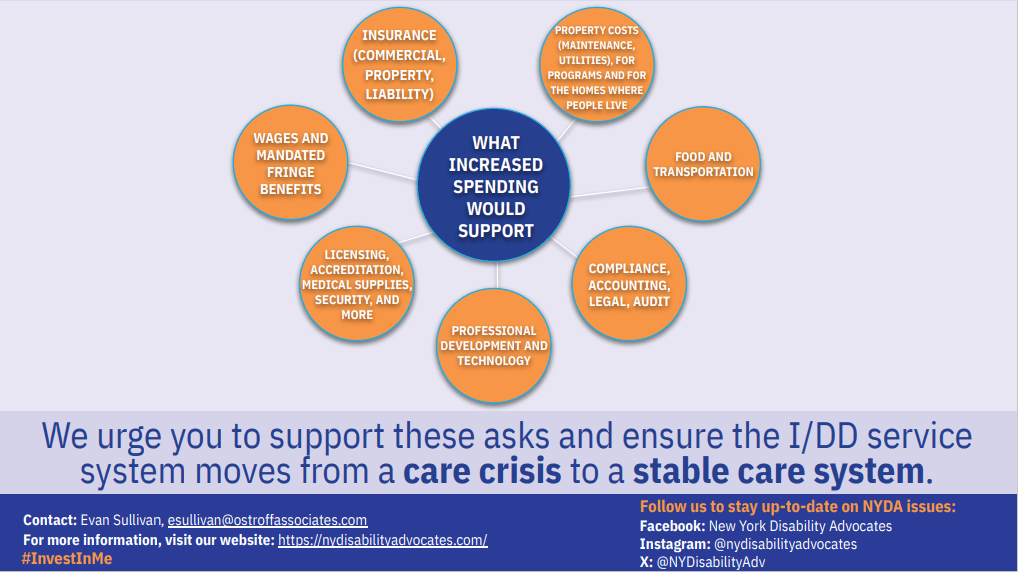
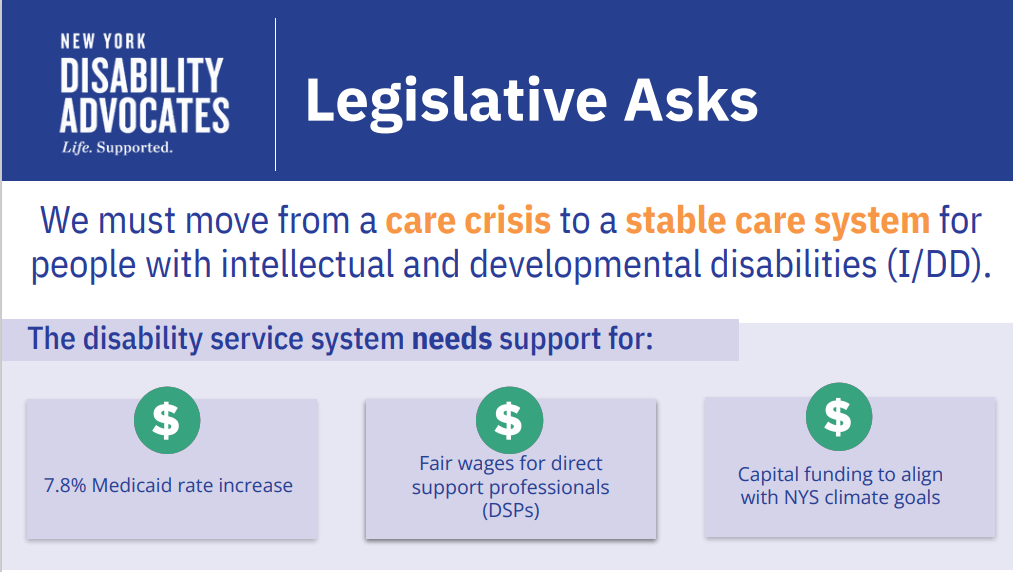
We are calling on her to include the following requests in the 2025-26 New York State Budget:Investment in I/DD services through a 7.8% Medicaid rate increase to stabilize non-profit provider agencies.Creation of a Wage Commission to examine the roles and responsibilities of human service workers and establish fair, sustainable compensation standards commensurate with that work.Enhanced Capital Funding to help agencies modernize their operations, making them more energy-efficient and in alignment with the state’s climate goals.
 We need YOUR voice in this fight. Click the button below and tell the Governor to invest in New Yorkers with disabilities!
Message the Governor NOW!
Thank you for being an advocate for people with disabilities. Consider joining the CP Family Group to stay up to date on disability issues and family supports.
Click the link below to log in and send your message:
https://www.votervoice.net/BroadcastLinks/H9wrLeLSS3nGqhGCJN2rPA

Click here to unsubscribe from this mailing list.

Social Security Overpays Billions to People, Many on Disability. Then It Demands the Money Back.

Please be aware of the situation even if it has not yet impacted you personally. This has the potential to have significant impact on our loved ones, families and providers.

Article

  https://kffhealthnews.org/news/article/social-security-overpayments-investigation/?fbclid=IwAR3KZV84uChkRd_tn6rgFenJXIiXRj6HafUl8lA5tQqKKPpjz7cJp-r2dsc

ABC Story

 https://abcnews.go.com/GMA/News/video/social-security-overpaying-billions-americans-103246629

Act now to support two critical disability rights issues!

This year, with your support, we defended cuts to Medicaid for the millions of people nationwide who rely on it. But our fight to protect and expand rights for people with intellectual and developmental disabilities isn’t over.

Please join us again in contacting your members of Congress about two priority issues.We desperately need more funding for HCBS so people with disabilities can access the vital care they need to thrive!
Medicaid home and community-based services (HCBS) play a vital role in helping people with disabilities live independently in the community—but a lack of funding for these services has left over 650,000 people stuck on waiting lists.Too many people are in limbo, unsure of when they will gain access to critical benefits, and many live segregated lives in the archaic institutions that still exist in 33 states.

Tell Congress to increase funding for HCBS so life in the community possible for all!
Act Now to Say #CareCantWait


Join us in demanding updates to SSI for the millions of people with disabilities who rely on it!Outdated rules to the Supplemental Security Income (SSI) program force millions of people with disabilities into poverty and prevent many others from getting married for risk of losing their much-needed benefits.Congress can change this by passing the SSI Savings Penalty Elimination Act, which would raise SSI asset limits for the first time in over 30 years and reduce marriage penalties related to SSI asset limits.Tell Congress to Update SSI!

Contact your Assemblymember and Senator

Contact Your Assemblymember(s) and Senator(s) and Urge Them to Prioritize Investments for the I/DD Community and the People who Support Them

The end of the State’s fiscal year is less than four short weeks away.

NY Alliance and its partners in NYDA expect one-house budget bills to be released within the next week or so. 

We remain hopeful that lawmakers will include an 8.5% cost-of-living-adjustment (COLA) increase for nonprofit provider agencies and the Direct Support Wage Enhancement (DSWE) for direct support staff to address the workforce crisis that has challenged our community for so long. 

WHAT ARE OUR NEXT STEPS?

As the State Budget process moves along, it’s important that we continue to advocate for the 8.5% COLA and the DSWE. Over the next few weeks, we’re calling on you, your colleagues, your family and friends to reach out to members of the State Assembly and State Senate to prioritize these crucial investments for the I/DD community and the people who support them.

HOW CAN YOU DO THIS?

One of the most effective ways to make your voice heard is by using social media to share your story and advocate for change. 

Use Social Media – We Have a Toolkit!

NYDA has prepared a social media toolkit that contains example posts, downloadable graphics, talking points and other helpful tips to help advocates and supporters like you take action online. 

Use Twitter or post on Facebook once or multiple times per day leading up to the State Budget announcements. (When you post, don’t forget to tag your State Senate and State Assembly members and the NYDA (@nydisabilityadv). To identify your elected officials and find their social handles use the NY Alliance Government Action Center.

Reach out to State Legislators by sending a Message

Send a message urging State Legislators to prioritize the COLA and DSWE in the One House Budgets through the NY Alliance’s Government Action Center “one-click” tool.

TOGETHER, WE CAN GET THIS DONE!

NYDA 2024 Executive Budget Statement

Statement from the New York Disability Advocates on Governor Hochul 2024 Executive Budget

Earlier this month, Governor Hochul outlined her administrations’ vision of the “New York Dream”, a government that will uplift all New Yorkers. Unfortunately, with the release of the Executive Budget today, the “New York dream” for people with intellectual and developmental disabilities (I/DD) and the individuals that provide life supporting services to them is not fully realized. 

Governor Hochul’s inclusion of a 2.5 % Cost-Of-Living-Adjustment (COLA) as part of the Executive Budget, simply does not provide the necessary resources to keep pace with the growing cost of providing services to people with developmental disabilities after a decade of cuts and lack of investment in these services. 

OPWDD’s own Strategic Plan, published in November, articulates Goal #1 as, “Improve the recruitment, retention and quality of the direct support workforce,” by “investing in the workforce.”  The system faces “a 35.6% turnover rate in the voluntary DSP workforce, a vacancy rate of 17.2% for full time positions, and a vacancy rate of 21.3% for part-time positions.”  

An adequate COLA increase is critical to address workforce turnover and increased operational costs. The Governor’s proposal to fund a COLA at 6% less than the system needs to sustain the status quo means that OPWDD will have some difficult decisions to make about where cuts to service delivery will happen for the 130,000 New Yorkers with I/DD and their families that rely upon them. 

With today’s announcement, we once again face the stark reality that nonprofit provider agencies for the I/DD community are overlooked and underfunded especially, considering OPWDD increased starting wages for their own workforce by 13%, who provide the same supports and services.  

Equity and support for all must make its way into the Governor’s and the Division of Budget’s dream for New York. Without that equity and support from our elected officials the New York Dream becomes a nightmare for the people with disabilities and their families, who are unable to get the resources they need to live their best lives. 

There are currently hundreds of people with I/DD waiting in hospitals, nursing homes, and psychiatric centers due to insufficient capacity in the OPWDD system. There are thousands more living at home with their aging caregivers who want to live independently with supports from OPWDD. This cannot be part of the New York Dream that Governor Hochul envisioned. 

New York lawmakers have a duty to serve all their residents, especially those who rely on them the most. We must work together to ensure that the I/DD community receives the proper recognition and resources it needs to build a sustainable future for the thousands of New Yorkers who need it. 

We are urging both houses of the New York Legislature to include an 8.5% Cost-Of-Living-Adjustment (COLA), as well as the establishment of a Direct Support Wage Enhancement (DSWE) to increase hourly pay for Direct Support workers in their respective one-house budgets. The fate of the I/DD community depends on it.

NYC FAIRFAMILY ADVOCACY & INFORMATION RESOURCES

HCBS Settings Rules are set to begin on March 17, 2023
(Home and Community Based Services)

The Center for Medicare and Medicaid Services (CMS) requires all states receiving Medicaid waiver funding to implement these rules.
Medicaid funds help pay for these services
 
CMS’s goal is to increase community integration and the settings rules are to help accomplish that. 
 
OPWDD Information: https://opwdd.ny.gov/providers/hcbs-settings-toolkit
 
OPWDD Power Point* from 12/15/22 Webinar for providers: Click Here 
 Note: OPWDD is preparing a Plain Language VersionJoin Us January 26th, 7pm for this Town Hall to learn: What do these rules mean for people with Intellectual and Developmental disabilities.
Do they match the needs of the individual or not,
what to do if they don’t and what can you do to protect your loved one
REGISTER TODAY To Register
Open Camera
Scan QR Code 

Or Click Here:

https://forms.gle/aYQyYdNQ39BMpEUL8
Ask Your Questions on the Form
 REGISTRATION REQUIRED
Confirmation will be emailed
If you do not receive an email, please email info@nycfair.org to verify your
email address

ZOOM Link will be emailed beginning 1/23/23 Congratulations !to Senator John Mannion & Assemblymember Rebecca Seawright,

Chairs of the Disabilities committees in the NYS Senate & Assembly

Introduce yourself
Tell them why they need to be our champions in Albany
 
Senator John Mannion:
https://www.nysenate.gov/senators/john-w-mannion

Assemblymember Rebecca Seawright: https://assembly.state.ny.us/mem/Rebecca-A-SeawrightRALLY IN ALBANY

ANOTHER OPPORTUNITY TO HAVE

OUR VOICES HEARD
Graphical user interface, text

Description automatically generatedDETAILS COMING SOONSAVE-THE-DATE

EDITORIAL

Albany Times Union, Sunday, October 2, 2022

It’s just heartless greed

Some insurance companies may be pocketing money meant for raises to alleviate a critical shortage of home care workers.

To comment: TULETTERS@TIMESUNION.COM

New York has a desperate shortage of home care workers to take care of sick, disabled, and frail people. Recognizing that dire situation, state lawmakers and Gov. Kathy Hochul put $7.7 billion in the state budget for wage increases to help retain and attract these vital employees.

But now it looks like hundreds of millions of dollars of that money may end up going to insurance companies that are keeping it for themselves.

https://digital.olivesoftware.com/olive/odn/albanytimesunion/Ads/ArticleInsert.htm

It’s a level of greed and opportunism in the face of a crisis that ought to shock the sensibilities of the governor and Legislature. And Attorney General Letitia James should look into whether there’s a civil or criminal case to be made here. Even it it doesn’t rise to criminality, it’s as offensive an abuse of public funds as the rampant fraud we witnessed in the false claims for unemployment benefits early in the COVID-19 pandemic.

As the Times Union’s Rachel Silberstein reports, the money was supposed to support minimum-wage increases of $2 an hour this year and $1 an hour next year. The increases were slated to start Oct. 1.

But some private insurance companies, in negotiations with home care agencies, are offering only 20 cents to 50 cents more an hour in reimbursement rates. The New York State Association of Health Care Providers says that as of last week, the vast majority of home care agencies reported no insurance companies even talking to them about raising reimbursement rates. Some even want to decrease rates.

The result, then, would be even worse than if the state had offered no new money at all. Because providers would have to pay more per hour but not be made whole by the insurance companies, they’d likely have to cut staffing and overtime pay and turn away clients insured by companies that won’t cover the wage hikes.

Certainly this sounds immoral, and it may not be legal. The state Department of Health says that under federal rules concerning how much money from premiums insurers and managed-care organizations have to spend on direct care, they can’t keep the state funds. The department intends to reinforce that message.

State leaders should deliver a message of their own — that keeping these public funds from getting to the workers is an egregious breach of trust. It’s not just about the pay, but about the health of an industry that so many vulnerable people depend on. Insurance companies are not just shortchanging the providers, they’re thwarting an important public health initiative.

Capital Region lawmakers — state Sen. Neil Breslin, D-Delmar, who heads the Senate Insurance Committee, and Assemblymen John T. McDonald III, D-Cohoes, and Phil Steck, D-Colonie, both members of the Assembly Insurance Committee, should call on their respective committees to convene and demand insurance executives come to Albany and explain themselves. And they should work with the Hochul administration to develop, if necessary, any new laws to force insurers to pass the money on, and retroactively pay anything they failed to do. And a penalty, if possible, might help drive home the point.

In the meantime, we offer some simple, clear, nonbureaucratic advice to the insurance industry: Do the right thing.