Category: ENYDDA ADVOCACY
Opposition to Managed Care
January 2023
Dear Governor Hochul,
Happy New Year! We welcome in the New Year with renewed hope for people with Intellectual and Developmental Disabilities (I/DD) and their families. Our independent family and self-advocacy organizations continue to oppose Managed Care support services for people with I/DD, and are against extending NYS legislative authorization to continue further exploration when it expires this year. The effort to pursue Managed Care for I/DD support services has already been extended for more than a decade. We believe that too much time and money has already been wasted. Extending the authorization will only result in delaying any effort to implement other needed changes to the service system.
In November of 2022, OPWDD awarded a $1.44 million consulting contract “to study and evaluate how the implementation of managed care would assist in improving Long Term Services and Supports (LTSS) for people with I/DD.” Previous studies to determine the effects of Managed Care for I/DD services show no evidence of cost benefit, improved access to services or quality of care in states that have attempted to transition.
- A 2019 study funded by the Texas Legislature concluded: “While there are savings achieved on Long Term Services and Support claims, the amount of increased administrative expenditures outweighs savings from claims” (www.tinyurl.com/TX-IDD-Deloitte-Report )
- The Medicaid and Chip Payment and Access Commission, a non-partisan group of experts concluded in 2021: “While much research has been conducted on whether Managed Care delivery systems result in better outcomes than fee for service (FFS), there is no definitive conclusion as to whether managed care improves or worsens access to or quality of care for beneficiaries www.macpac.gov/subtopic/managed-cares-effect-on-outcomes )
Even more disconcerting is a NYS funded study by Deloitte that estimates the cost for initial implementation of Managed Care for I/DD services would be $200 million and would result in a similar increase in annual administrative costs.
The money spent on studying managed care over the last decade might have been put to better use serving the needs of people with I/DD and the workforce supporting them. Given the urgency of stabilizing and improving the workforce, increasing residential options, improving access and diversity as laid out in OPWDD’s Strategic Plan, this continued distraction over managed care comes with the even greater cost of failing to take needed action to implement these goals. Please let the authorization to explore Managed Care expire so that stakeholders can immediately get to work accelerating changes that have a meaningful and positive impact on people’s lives.
Respectfully submitted on behalf of Families and Self-Advocates Representing People with Intellectual and Developmental Disabilities across New York State
CC: Dr. James V. McDonald, Acting Commissioner Department of Health
Kerri Neifeld, Office for People With Developmental Disabilities
Jihoon Kim, Deputy Secretary for Human Services and Mental Hygiene
Kim Hill, Chief Disability Officer
Kathryn Garcia, Director of State Operations
Sandra L. Beattie, Division of Budget
Senate and Assembly Disability Committee Chairs
Senate Majority Leader
Assembly Speaker
Senate and Assembly Legislators
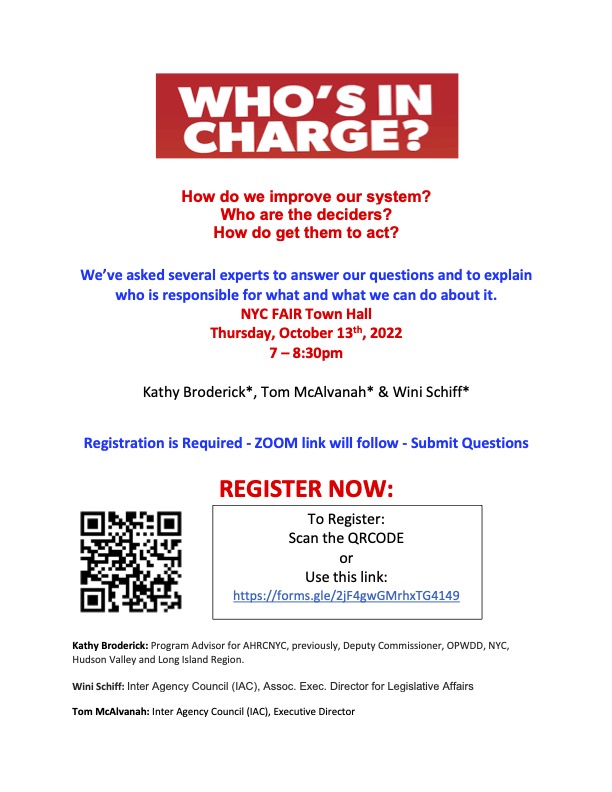
NYC FAIR Town Hall
Debunking the Myths of Managed Care
Letter from ENYDDA, NYC Fair, DDAWNY,LIANDD, SWAN, GROW, SOYAN, NYADD and New York Self Determination Coalition
Dear Governor Hochul,
We are independent consumer and family advocates across NYS, and we want you to know: We remain opposed to Managed Care Support Services for People with Intellectual and Developmental Disabilities (I/DD). Managed Care for I/DD services will not save money, will not provide better care and will not address issues of equity and access to services.
The OPWDD service system faces many challenges. Growing demand, problems with supply and quality, and an on-going work-force shortage have amplified those challenges. Following more than a decade of system transformation and exploration, we are hearing a repeated message from some, that Managed Care for I/DD is the solution. This narrative creates the impression that a transition to Managed Care for I/DD services is inevitable.
Managed Care promises to improve access by leveraging its provider networks. It promises to improve quality by instituting value-based payments and risk sharing. It promises to bring more innovation, and many, many more promises. These promises sound too good to be true for a very simple reason – they are too good to be true.
We reject the unproven aspirations of managed care for I/DD support services. Instead, we want to focus on making improvements that have a direct and positive impact on people’s lives, starting now. As the exploration of Managed Care for I/DD services continues, we will continue to challenge it. Managed Care for I/DD services is not here, is not inevitable, and is not a good idea. This is the first of a series, ‘Debunking the Myths of Managed Care’. Please reach out to any one of us to discuss this issue.
Thank you,
Respectfully submitted on behalf of;
Families and Self-Advocates Representing People with Intellectual and Developmental Disabilities across New York State
CC: Dr. Mary Bassett, Department of Health
Kerri Neifeld, Office for People With Developmental Disabilities
Jihoon Kim, Deputy Secretary for Human Services and Mental Hygiene
Kim Hill, Chief Disability Officer
Robert Mujica, Division of Budget
Senate and Assembly Disability Committee Chairs
Senate Majority Leader
Assembly Speaker
Senate and Assembly Legislators
GOVERNOR KATHY HOCHUL ANNOUNCES $10 MILLION PARTNERSHIP TO ASSIST DIRECT SUPPORT WORKERS
8/15/2022
Three-year Agreement with National Alliance for Direct Support Professionals to Expand Opportunities; Professionalize Workforce
Partnership to Help Address Ongoing Worker Shortages in the Developmental Disabilities Field
Governor Kathy Hochul today announced that the New York State Office for People With Developmental Disabilities has entered into a $10 million partnership with the National Alliance for Direct Support Professionals to expand opportunities for professional credentialing for direct support professionals in the developmental disabilities field throughout New York State. The three-year agreement will help professionalize the direct support professional workforce and address worker shortages.
“Workforce shortages are putting a tremendous strain on our dedicated direct service professionals, and in response New York is taking action to provide career advancement and growth opportunities in this crucial field,” Governor Hochul said. “This $10 million partnership to expand credentialing will prove critical in providing support for training, education and expanded recruitment and retention efforts – an important step in meeting the needs of New Yorkers with developmental disabilities.”
OPWDD’s partnership with the National Alliance will provide access to three levels of direct support professionals credentialing and its frontline supervisor certification through participation in its E-Badge Academy. The project is supported by federal funds OPWDD is receiving through the American Rescue Plan Act of 2021.
The National Alliance credential is competency-based and modeled on the Centers for Medicaid and Medicare Services’ Direct Service Workforce Core Competencies and the National Alliance Code of Ethics.
Founded in 1996, the National Alliance for Direct Support Professionals’ mission is to enhance the quality of support provided to people with disabilities through the provision of products, services and certifications which elevate the status of direct support workers. The organization strongly promotes recognition and identity of direct support professionals to spur meaningful public policy investments, while also advancing the knowledge, skills, and values of this occupation.
In the coming weeks, the National Alliance will release a request for proposals for eligible home and community-based service provider organizations to participate in the grant and claim seats in the E-badge Academy for staff. The National Alliance will provide credentialing or certification for about 2,442 direct service professionals and frontline supervisors over the length of the three-year contract.
The project will provide bonuses for participating direct service professionals. In addition, the project will reimburse employers for training hours undertaken by their staff.
Office for People with Developmental Disabilities Commissioner Kerri Neifeld said, “Expanding access to this industry-recognized credential will improve the competence and skills of our workforce and ultimately increase retention rates. It will provide our dedicated frontline staff who have been working tirelessly to meet the needs of New Yorkers with developmental disabilities under tremendous pressure the professional advancement and career opportunities they so well deserve. And, most importantly, it will help to ensure that thousands of New Yorkers those who need caring, expert direct service professionals to show up every day ready to meet their needs will receive the services they need to pursue their personal best and live their most fulfilling lives.”
Representative Kathleen Rice said, “Direct Support Professionals provide critical patient care and allow the most vulnerable New Yorkers to live independent, meaningful lives, but rarely do they receive pay, benefits, or training commensurate with the importance of their work. In Congress, I lead the Recognizing the Role of Direct Support Professionals Act to help the federal government understand and address the needs of this workforce, and I’m grateful for Governor Hochul’s actions to expand career opportunities for DSPs and reduce the shortage of homecare workers in New York.”
State Senator John W. Mannion said, “Direct Support Professionals need our support because the workforce crisis is having a profound impact on the ability to deliver services and necessary care. Expanding training and credentialing will allow DSPs the ability to advance professionally while helping to recruit and retain more compassionate New Yorkers into the care economy. This is an important step towards providing some relief for our overwhelmed and unfairly burdened DSPs. Governor Hochul has been a partner in addressing the workforce crisis and I look forward to working together to deliver additional solutions to this long standing problem.”
National Alliance for Direct Support Professionals President and Chief Executive Officer Joseph MacBeth said, “We are proud to be working with OPWDD and the New York provider community in demonstrating the value of direct support professional credentialing by providing access to the E-Badge Academy for nearly 2500 direct service professionals and frontline supervisors. The workforce crisis is a long-standing and complex issue that requires interventions in many areas. Recognizing the demonstration of skills and providing financial incentives for high-performing direct support professionals and frontline supervisors is an important first step to being recognized as a profession.”
New York Alliance for Inclusion and Innovation President & CEO Michael Seereiter said, “The NY Alliance for Inclusion and Innovation applauds the National Alliance for Direct Support Professionals in working together with OPWDD to administer a rigorous credentialing program for direct support professionals that will allow direct service professionals to advance their knowledge, values, and skills by obtaining certification. It offers a path to a career ladder and aides in addressing the DSP workforce shortage in addition to supporting DSPs to continue providing quality supports and services for individuals with intellectual and developmental disabilities.”
This initiative is part of a greater effort to enhance, improve and transform key aspects of the OPWDD service system using COVID-19 relief funds awarded by the federal CMS. These funds are targeted to specific activities across a wide range of OPWDD programs and provide a timely opportunity to address critical challenges. OPWDD’s plans for all of its ARPA funds can be found at: https://opwdd.ny.gov/american-rescue-plan-act-arpa.
Final Budget Includes Significant Investment In I/DD Field
April 8, 2022
From The ARC New York
The Governor and Legislature reached agreement on the New York State budget late last night, after extensive negotiations. This afternoon, the Senate and Assembly passed the Health and Mental Hygiene budget bill (A9007C/S8007C), which outlines the specific funding for our field, and realizes many of our initial advocacy priorities.
The Enacted Budget includes a 5.4% cost-of-living adjustment (COLA), expanded eligibility of the Statewide Health Care Transformation Program (SHCFTP) to include community-based I/DD providers, and changes in language so our clinical staff can access the Nurses Across New York (NANY) loan repayment program. Yesterday, Governor Hochul mentioned an agreement to include $1.2 billion in bonuses for essential healthcare workers. This is the same amount appropriated in her Executive Budget, which included bonuses of up to $3,000 for Direct Support Professionals. We expect language outlining the direct care workforce retention bonuses will be released later today.
The final budget reflects and expands on the significant investment originally outlined in the Executive Budget. This is by far the largest investment New York state has made in the I/DD field in over a decade. Following the release of the one-house bills, we shifted our ask to support the Assembly proposal to forgo workforce bonuses in favor of an 11% COLA, which we saw as the most straightforward and effective way to allocate the funds committed in all budget proposals. Although we did not achieve the 11% COLA as proposed in the Assembly one-house bill, we were successful with our initial request – and in securing recognition of the crisis we are facing and the need for substantial investment in the I/DD field.
This success is due in no small part to the ardent advocacy from The Arc New York family. Since last summer, we have held rallies, garnered media attention, engaged with our legislators, and sent more than 17,000 letters calling for significant and sustained investment in essential supports and services for New Yorkers with I/DD. Our voices have finally been heard.
With this budget, the Hochul administration and the legislature have demonstrated a commitment to the voluntary provider sector, our direct care workforce, and the individuals and families we support. These investments are only the start of a much larger conversation about how to adequately fund equitable wages for our dedicated workforce, and ensure sustained investment the New York’s system supports and services. Our fight isn’t over, but the landscape has shifted, and we will continue to raise our voices together to achieve lasting support and solutions.
We will continue to advocate for a DSP Tax credit, which was not included in any of the proposed budget. The Education, Labor and Family Assistance (ELFA) Article VII budget bill and Aid to Localities, Capital Projects, and State Operations appropriation bills have yet to be introduced. We will provide necessary updates as bills are introduced and budget language is analyzed.
On behalf of The Arc New York, we thank each of you for your advocacy and your tireless contributions toward realizing our shared mission to provide New Yorkers with disabilities the ordinary and extraordinary opportunities of life!
Letter from the Statewide Advocacy Network of New York


NYDA Lawsuit Successful
In a State of New York Supreme Court stipulation of dismissal without prejudice agreement reached between NYDA providers and NYS, the State has agreed to not retroactively implement their proposed IRA and day hab rate reductions which were scheduled to take place in 2020 (and moved to 2021). These reductions included the elimination of the IRA occupancy factor, the reduction in the number of IRA therapy days, and the reduction of retainer and therapy day hab payments.
The State has also agreed to file an amended Appendix K if needed to propose a delay to those provisions until six months after the end of the federal public health emergency declared by the DHHS.
Should CMS not approve the Appendix K amendment, the State has also agreed to not retroactively recoup any funds from providers as it relates to these proposed reductions for the period of time in which the rate cuts were not implemented.
This is at least a temporary win for the providers but they could face these reductions in the future as indicated above.
Acting Commissioner Kerri Neifeld at the 1/6 Family Advocacy Information Resource Town Hall
Hospital Visitation Guidance
With the uptick in Covid-19 cases and the upcoming flu season, ENYDDA wanted to make sure all of our members had access to the current OPWDD guidelines regarding visitation during the hospitalization of any one with developmental disabilities. Below is the link to OPWDD’s guidance that was issued on 6/7/21 and remains in effect currently.

