Social Security Overpays Billions to People, Many on Disability. Then It Demands the Money Back.

Please be aware of the situation even if it has not yet impacted you personally. This has the potential to have significant impact on our loved ones, families and providers.

Article

  https://kffhealthnews.org/news/article/social-security-overpayments-investigation/?fbclid=IwAR3KZV84uChkRd_tn6rgFenJXIiXRj6HafUl8lA5tQqKKPpjz7cJp-r2dsc

ABC Story

 https://abcnews.go.com/GMA/News/video/social-security-overpaying-billions-americans-103246629

A Parent’s Plea to Remedy the DSP Workforce Crisis

By Karen Nagy | April 6, 2023

The day Sean was born was the best day of my life. I remember when I first saw him, I knew I would go to the ends of the Earth to ensure he had every opportunity to thrive. So, when we found out he had autism at two years of age, my priority was building a support system that would ensure his needs would always be met and that he would grow to his fullest potential for independence and success. 

Like 85% of New Yorkers with Intellectual and Developmental Disabilities (I/DD) and their families, we turned to our local nonprofit service provider, Wildwood Programs to help us establish that support system over his lifetime. Sean is now an adult and lives in a Wildwood residence. The incredible and dedicated Direct Support Professionals (DSPs) who support his intensive social, communicative, and behavioral needs are his lifeline and uplift him every day. Our child has blossomed into the bright, happy, and secure individual he is today because of the positive relationships he has formed with the committed DSPs who provide supervision, care, and emotional support.

Yet, the harsh reality is that it has become increasingly difficult for families like mine to access much-needed direct support services. For over a decade, New York’s nonprofit provider agencies have been plagued by chronic underfunding and cuts that have culminated in a dire workforce crisis. DSPs are leaving their positions in droves because nonprofit providers lack the funding to offer fair wages. Our family realizes that Sean’s progress would be lost without Wildwood’s most precious resource; its dedicated staff.

To put an end to this crisis once and for all, we need permanent, long-term solutions from the State. Governor Hochul and the State Legislature must include at least an 8.5% cost-of-living adjustment (COLA) increase in this year’s final budget to ensure agencies can keep up with rising operational costs and support their already severely depleted workforce. 

DSPs are highly skilled professionals that are responsible for providing crucial support for individuals with I/DD – but in New York, they receive just above minimum wage for their essential work. As a result, too many aspiring and current DSPs are opting for higher-paying jobs in competing sectors such as retail and food service.

The statewide vacancy rate for direct support positions in New York is currently upwards of 20%, with nearly 20,000 vacancies that the nonprofit sector has been unable to fill. This is unacceptable and unsustainable. 

If we go on like this, what happens to the 130,000 New Yorkers with I/DD, like Sean, who depend on DSPs for life-sustaining care? In short, they’re left behind.

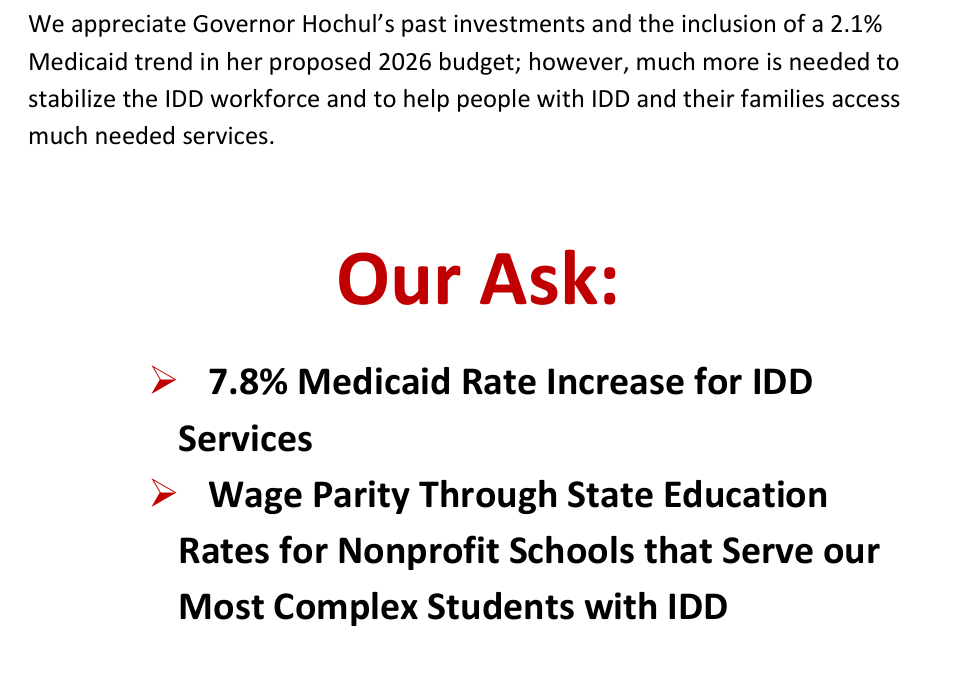
As part of the 2024 Executive Budget, Governor Kathy Hochul included a statewide 2.5% COLA increase for the I/DD service sector. This is nowhere near enough to provide the necessary resources for nonprofit provider agencies. Inflation has caused operating costs for nonprofit providers to increase significantly, plus staff turnover is costing them an additional $100.5 million each year. Anything less than 8.5% could cause all prior progress made in stabilizing and helping the sector to be lost. Providers already have to reduce and shut down vital programs and services – and New York’s most vulnerable will suffer as a result. It is my child who will suffer.

An 8.5% COLA increase will also increase funding available to offer competitive wages. This is how quality staff can be recruited and, more importantly, retained. This past year, New York provided two wage increases for state-operated direct support staff. But, DSPs employed by nonprofit providers, like Sean’s, have received none. As a result, DSPs working at nonprofit agencies earn 70% of their state-operated counterparts’ salaries, although they do the same jobs for the same community. 

We must put an end to this and ensure all DSPs earn a fair, livable wage in exchange for their essential work. This isn’t just the right thing to do – it’s also a necessary step in ending the workforce crisis that has plagued our community for too long. 

Every New Yorker, including those living with disabilities, deserves the highest quality of life possible. By enacting an 8.5% cost-of-living adjustment (COLA), New Yorkers with I/DD can live a better life, and families like mine can breathe without the fear of not knowing if our loved ones will be able to get the support they need.

Karen Nagy, Rexford NY

Contact your Assemblymember and Senator

Contact Your Assemblymember(s) and Senator(s) and Urge Them to Prioritize Investments for the I/DD Community and the People who Support Them

The end of the State’s fiscal year is less than four short weeks away.

NY Alliance and its partners in NYDA expect one-house budget bills to be released within the next week or so. 

We remain hopeful that lawmakers will include an 8.5% cost-of-living-adjustment (COLA) increase for nonprofit provider agencies and the Direct Support Wage Enhancement (DSWE) for direct support staff to address the workforce crisis that has challenged our community for so long. 

WHAT ARE OUR NEXT STEPS?

As the State Budget process moves along, it’s important that we continue to advocate for the 8.5% COLA and the DSWE. Over the next few weeks, we’re calling on you, your colleagues, your family and friends to reach out to members of the State Assembly and State Senate to prioritize these crucial investments for the I/DD community and the people who support them.

HOW CAN YOU DO THIS?

One of the most effective ways to make your voice heard is by using social media to share your story and advocate for change. 

Use Social Media – We Have a Toolkit!

NYDA has prepared a social media toolkit that contains example posts, downloadable graphics, talking points and other helpful tips to help advocates and supporters like you take action online. 

Use Twitter or post on Facebook once or multiple times per day leading up to the State Budget announcements. (When you post, don’t forget to tag your State Senate and State Assembly members and the NYDA (@nydisabilityadv). To identify your elected officials and find their social handles use the NY Alliance Government Action Center.

Reach out to State Legislators by sending a Message

Send a message urging State Legislators to prioritize the COLA and DSWE in the One House Budgets through the NY Alliance’s Government Action Center “one-click” tool.

TOGETHER, WE CAN GET THIS DONE!

Opposition to Managed Care

January 2023

Dear Governor Hochul,

Happy New Year!  We welcome in the New Year with renewed hope for people with Intellectual and Developmental Disabilities (I/DD) and their families.  Our independent family and self-advocacy organizations continue to oppose Managed Care support services for people with I/DD, and are against extending NYS legislative authorization to continue further exploration when it expires this year.  The effort to pursue Managed Care for I/DD support services has already been extended for more than a decade.  We believe that too much time and money has already been wasted.    Extending the authorization will only result in delaying any effort to implement other needed changes to the service system.  

In November of 2022, OPWDD awarded a $1.44 million consulting contract “to study and evaluate how the implementation of managed care would assist in improving Long Term Services and Supports (LTSS) for people with I/DD.”  Previous studies to determine the effects of Managed Care for I/DD services show no evidence of cost benefit, improved access to services or quality of care in states that have attempted to transition.

  • A 2019 study funded by the Texas Legislature concluded: “While there are savings achieved on Long Term Services and Support claims, the amount of increased administrative expenditures outweighs savings from claims” (www.tinyurl.com/TX-IDD-Deloitte-Report )
  • The Medicaid and Chip Payment and Access Commission, a non-partisan group of experts concluded in 2021: “While much research has been conducted on whether Managed Care delivery systems result in better outcomes than fee for service (FFS), there is no definitive conclusion as to whether managed care improves or worsens access to or quality of care for beneficiaries  www.macpac.gov/subtopic/managed-cares-effect-on-outcomes )

Even more disconcerting is a NYS funded study by Deloitte that estimates the cost for initial implementation of Managed Care for I/DD services would be $200 million and would result in a similar increase in annual administrative costs. 

The money spent on studying managed care over the last decade might have been put to better use serving the needs of people with I/DD and the workforce supporting them.  Given the urgency of stabilizing and improving the workforce, increasing residential options, improving access and diversity as laid out in OPWDD’s Strategic Plan, this continued distraction over managed care comes with the even greater cost of failing to take needed action to implement these goals.  Please let the authorization to explore Managed Care expire so that stakeholders can immediately get to work accelerating changes that have a meaningful and positive impact on people’s lives.

Respectfully submitted on behalf of Families and Self-Advocates Representing People with Intellectual and Developmental Disabilities across New York State

CC:         Dr. James V. McDonald, Acting Commissioner Department of Health

               Kerri Neifeld, Office for People With Developmental Disabilities

               Jihoon Kim, Deputy Secretary for Human Services and Mental Hygiene

               Kim Hill, Chief Disability Officer

Kathryn Garcia, Director of State Operations

               Sandra L. Beattie, Division of Budget

               Senate and Assembly Disability Committee Chairs

               Senate Majority Leader

               Assembly Speaker

Senate and Assembly Legislators

Debunking the Myths of Managed Care

Letter from ENYDDA, NYC Fair, DDAWNY,LIANDD, SWAN, GROW, SOYAN, NYADD and New York Self Determination Coalition

Dear Governor Hochul,

We are independent consumer and family advocates across NYS, and we want you to know: We remain opposed to Managed Care Support Services for People with Intellectual and Developmental Disabilities (I/DD). Managed Care for I/DD services will not save money, will not provide better care and will not address issues of equity and access to services.

The OPWDD service system faces many challenges. Growing demand, problems with supply and quality, and an on-going work-force shortage have amplified those challenges. Following more than a decade of system transformation and exploration, we are hearing a repeated message from some, that Managed Care for I/DD is the solution. This narrative creates the impression that a transition to Managed Care for I/DD services is inevitable.

Managed Care promises to improve access by leveraging its provider networks.  It promises to improve quality by instituting value-based payments and risk sharing.  It promises to bring more innovation, and many, many more promises.  These promises sound too good to be true for a very simple reason – they are too good to be true.

We reject the unproven aspirations of managed care for I/DD support services.  Instead, we want to focus on making improvements that have a direct and positive impact on people’s lives, starting now. As the exploration of Managed Care for I/DD services continues, we will continue to challenge it. Managed Care for I/DD services is not here, is not inevitable, and is not a good idea. This is the first of a series, ‘Debunking the Myths of Managed Care’.  Please reach out to any one of us to discuss this issue. 

Thank you,

Respectfully submitted on behalf of;

Families and Self-Advocates Representing People with Intellectual and Developmental Disabilities across New York State

CC:         Dr. Mary Bassett, Department of Health

                Kerri Neifeld, Office for People With Developmental Disabilities

                Jihoon Kim, Deputy Secretary for Human Services and Mental Hygiene

                Kim Hill, Chief Disability Officer

                Robert Mujica, Division of Budget

                Senate and Assembly Disability Committee Chairs

                Senate Majority Leader

                Assembly Speaker

Senate and Assembly Legislators

GOVERNOR KATHY HOCHUL ANNOUNCES $10 MILLION PARTNERSHIP TO ASSIST DIRECT SUPPORT WORKERS

8/15/2022

Three-year Agreement with National Alliance for Direct Support Professionals to Expand Opportunities; Professionalize Workforce

Partnership to Help Address Ongoing Worker Shortages in the Developmental Disabilities Field

Governor Kathy Hochul today announced that the New York State Office for People With Developmental Disabilities has entered into a $10 million partnership with the National Alliance for Direct Support Professionals to expand opportunities for professional credentialing for direct support professionals in the developmental disabilities field throughout New York State. The three-year agreement will help professionalize the direct support professional workforce and address worker shortages.

“Workforce shortages are putting a tremendous strain on our dedicated direct service professionals, and in response New York is taking action to provide career advancement and growth opportunities in this crucial field,” Governor Hochul said. “This $10 million partnership to expand credentialing will prove critical in providing support for training, education and expanded recruitment and retention efforts – an important step in meeting the needs of New Yorkers with developmental disabilities.”

OPWDD’s partnership with the National Alliance will provide access to three levels of direct support professionals credentialing and its frontline supervisor certification through participation in its E-Badge Academy. The project is supported by federal funds OPWDD is receiving through the American Rescue Plan Act of 2021.

The National Alliance credential is competency-based and modeled on the Centers for Medicaid and Medicare Services’ Direct Service Workforce Core Competencies and the National Alliance Code of Ethics.

Founded in 1996, the National Alliance for Direct Support Professionals’ mission is to enhance the quality of support provided to people with disabilities through the provision of products, services and certifications which elevate the status of direct support workers. The organization strongly promotes recognition and identity of direct support professionals to spur meaningful public policy investments, while also advancing the knowledge, skills, and values of this occupation.

In the coming weeks, the National Alliance will release a request for proposals for eligible home and community-based service provider organizations to participate in the grant and claim seats in the E-badge Academy for staff. The National Alliance will provide credentialing or certification for about 2,442 direct service professionals and frontline supervisors over the length of the three-year contract.

The project will provide bonuses for participating direct service professionals. In addition, the project will reimburse employers for training hours undertaken by their staff.

Office for People with Developmental Disabilities Commissioner Kerri Neifeld said, “Expanding access to this industry-recognized credential will improve the competence and skills of our workforce and ultimately increase retention rates. It will provide our dedicated frontline staff who have been working tirelessly to meet the needs of New Yorkers with developmental disabilities under tremendous pressure the professional advancement and career opportunities they so well deserve. And, most importantly, it will help to ensure that thousands of New Yorkers those who need caring, expert direct service professionals to show up every day ready to meet their needs will receive the services they need to pursue their personal best and live their most fulfilling lives.”

Representative Kathleen Rice said, “Direct Support Professionals provide critical patient care and allow the most vulnerable New Yorkers to live independent, meaningful lives, but rarely do they receive pay, benefits, or training commensurate with the importance of their work. In Congress, I lead the Recognizing the Role of Direct Support Professionals Act to help the federal government understand and address the needs of this workforce, and I’m grateful for Governor Hochul’s actions to expand career opportunities for DSPs and reduce the shortage of homecare workers in New York.”

State Senator John W. Mannion said, “Direct Support Professionals need our support because the workforce crisis is having a profound impact on the ability to deliver services and necessary care. Expanding training and credentialing will allow DSPs the ability to advance professionally while helping to recruit and retain more compassionate New Yorkers into the care economy. This is an important step towards providing some relief for our overwhelmed and unfairly burdened DSPs. Governor Hochul has been a partner in addressing the workforce crisis and I look forward to working together to deliver additional solutions to this long standing problem.”

National Alliance for Direct Support Professionals President and Chief Executive Officer Joseph MacBeth said, “We are proud to be working with OPWDD and the New York provider community in demonstrating the value of direct support professional credentialing by providing access to the E-Badge Academy for nearly 2500 direct service professionals and frontline supervisors. The workforce crisis is a long-standing and complex issue that requires interventions in many areas. Recognizing the demonstration of skills and providing financial incentives for high-performing direct support professionals and frontline supervisors is an important first step to being recognized as a profession.”

New York Alliance for Inclusion and Innovation President & CEO Michael Seereiter said, “The NY Alliance for Inclusion and Innovation applauds the National Alliance for Direct Support Professionals in working together with OPWDD to administer a rigorous credentialing program for direct support professionals that will allow direct service professionals to advance their knowledge, values, and skills by obtaining certification. It offers a path to a career ladder and aides in addressing the DSP workforce shortage in addition to supporting DSPs to continue providing quality supports and services for individuals with intellectual and developmental disabilities.”

This initiative is part of a greater effort to enhance, improve and transform key aspects of the OPWDD service system using COVID-19 relief funds awarded by the federal CMS. These funds are targeted to specific activities across a wide range of OPWDD programs and provide a timely opportunity to address critical challenges. OPWDD’s plans for all of its ARPA funds can be found at: https://opwdd.ny.gov/american-rescue-plan-act-arpa.